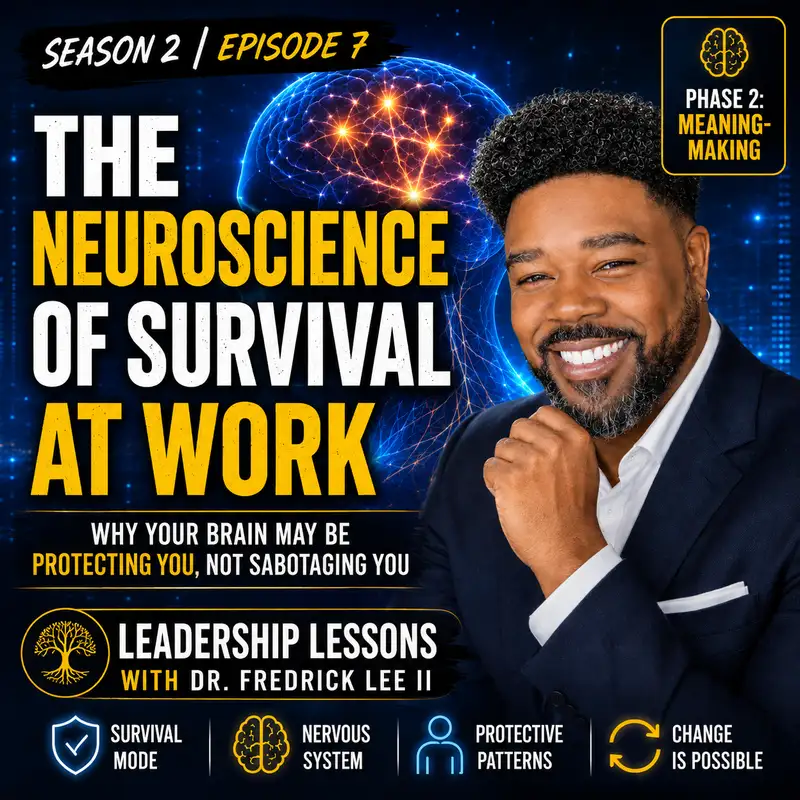
The Neuroscience of Survival at Work
Mr. Change (01:30.488)
Have you ever received a message at work that simply said, can we talk?
No accusation, no explanation, just three little words. Still, before you knew what the conversation was about, your stomach dropped, your shoulders tightened, your mind opened 12 possible scenarios, and none of them ended with, I just wanted to thank you. You started reviewing your last email, you replayed the meeting from yesterday.
You check the calendar invite for clues. You looked at the names on the invitation, the time that was allotted, and whether human resources had been added. The conversation had not happened, but your body had already attended it. I know that response personally. I can lead a complex operation, manage difficult conversations, speak to a room, make high-stakes decisions.
And still feel my nervous system react to ambiguity before my experience has a chance to speak.
My credentials do not enter the room first. My nervous system does. As someone living with ADHD, OCD, anxiety, depression, I have learned that uncertainty can become very loud inside me.
Mr. Change (03:03.574)
ADHD can pull my attention toward the newest and most urgent signal. OCD can keep asking for certainty that work rarely provides. Anxiety can take an empty space and fill it with a complete risk assessment. From the outside, I may look thoughtful and prepared. Inside, my system may be trying to determine whether I am solving a problem or surviving one.
That distinction matters because a lot of what we call overreacting, shutting down, people pleasing, defensiveness, procrastination, or control may begin as an attempt to create safety.
Scursums.
Mr. Change (04:01.792)
It does not mean every reaction is healthy. It does not mean every behavior is acceptable. It means the behavior has a reason. And when you understand the reason, you gain more choice about what happens next. This episode begins the meaning-making stage of season two. For the first six episodes, we named what does not feel right. We talked about
unsafe work, normalized toxicity, harmful environments, burnout, silence, and exhaustion. Now we ask a different question.
Why does my body react this way? Why do I go blank when I know the answer? Why do I agree when I want to say no?
Why do I become controlling when I feel uncertain? Why can one email change the temperature of my entire day? Today, we talk about the neuroscience of survival at work. Stay with me through the end because I'm going to give you a practical way to map your own survival response and move from automatic reaction to a more intentional choice.
If this conversation feels familiar, place this sentence down in the comments. My reaction has a history. Let's get into it.
Mr. Change (05:51.586)
Welcome to Leadership Lessons. I am Dr. Fredrick Lee II. I am your change practitioner, and I teach you how to use emotional intelligence, applied neuroscience, and change management to understand the human side of change at work in life and in relationships. We're calling season two Empowered, the Inner Work of Sustainable Change. And today's episode is titled The Neuroscience of Survival at Work.
Before we go deeper, I want you to follow and subscribe so you can move through this season in order. Share this episode with the person who keeps asking, why do I react like this at work when I know better? This episode marks a shift in the season. The first six episodes had
Mr. Change (06:47.106)
The first six episodes had us in the awareness stage, which says something is not right. Now we're moving into the meaning-making stage, which says, now I understand why. That shift matters because shame grows in the absence of explanation. When people do not understand their reactions, they often turn the reaction into an identity. I froze, so I must be weak.
I avoided the conversation, so I must be a coward. I became defensive, so I must be difficult. I said yes again, so I must have no backbone. Those conclusions are usually too simple. Current workplace conversations are filled with phrases such as survival mode, nervous system regulation, high functioning anxiety, functional freeze, workplace trauma.
Neurodivergent masking and fight, flight, freeze, or fawn. Some of these are clinical concepts, some are popular language trying to describe a real experience. They should not all be treated as diagnoses. Still, the interest tells us something. People are looking for language that explains why they can be competent, intelligent, and self-aware.
While their body still responds as if something is at risk. The pressure is not imaginary. See, Gallup's 2026 workplace data found that half the employees in the United States and Canada experienced significant stress during the previous day. Leaders reported high stress too, along with more anger, sadness, and loneliness than the people they led.
Survival at work is not a niche conversation. It is showing up in offices, hospitals, classrooms, warehouses, homes, virtual meetings, and executive suites. So the goal today is not to diagnose your workplace or your nervous system through a podcast. The goal is to help you notice a pattern with more accuracy and less shame.
Mr. Change (09:17.208)
Here's the central idea for this episode. Your nervous system can respond to a workplace threat before your conscious mind has decided whether the situation is dangerous. That is not a design flaw. It's part of how human beings survive. Your brain is constantly taking in information: the tone of voice, the facial expressions, the silence, the status, uncertainty, sudden change, past experience.
Whether a leader follows through, whether speaking honestly has been safe before, much of that scanning happens quickly and outside deliberate thought. When your brain predicts threat, your body prepares to protect you. So your heart rate may change, your muscles may tense, attention may narrow, you may feel heat, nausea, restlessness, urgency, numbness.
Mental fog. At work, that protection may take several different forms. Fight can look like defensiveness, sharp language, arguing every point, controlling the process, correcting people publicly, or becoming unusually rigid.
Fight can look like avoiding a meeting, delaying an in mail.
Mr. Change (10:44.014)
Calling out, changing the subject, staying busy with low risk tasks, or quietly looking for another job.
Freeze can look like going blank, losing access to words, being unable to decide, staring at a task without starting it, or remaining silent when you have something important to say.
Fawn, sometimes called appeasement, can look like agreeing too quickly, over apologizing, taking responsibility for everybody's emotions, softening the truth, laughing when you are uncomfortable, or saying yes because disappointing someone else feels unsafe.
Mr. Change (11:35.98)
These responses are not permanent personality types. People can move among them depending on the situation, the relationship, the level of power involved, and what their system has learned. A person may fight with a peer, freeze with an executive, flee from conflict at home, and appease a parent. The responses contextual.
That's why the same employee can look confident in one meeting and completely shut down in another. It is also why the same workplace event can affect two people differently. Two people can ride the same roller coaster.
One person gets off laughing, the other person gets off sick. They were on the same ride, but they did not have the same experience. At work, two employees can receive the same feedback, experience the same reorganization, or report to the same leader. One may experience challenge, the other may experience threat. Difference does not automatically mean someone is exaggerating or someone else.
is insensitive. It means impact is shaped by history, biology, identity, power, available support, and the meaning the person assigns to what happened.
Mr. Change (13:17.986)
When we misunderstand survival behavior, we make poor leadership decisions. We call someone resistant when they are confused and afraid. We call someone disengaged when they have learned that visible enthusiasm creates more work without more support. We call someone difficult when they're trying to regain control in an unpredictable system.
We call someone unprepared when stress has interrupted their access to work and memory. We call someone agreeable when they are afraid to tell us the truth. Those labels may describe what we see, but they do not explain what is happening. The same mistake happens inside of us.
Mr. Change (14:16.716)
You may know you need to send an email, but your body treats the task like a confrontation. You may know the meeting is routine, but a previous leader used routine meetings to surprise, embarrass, or discipline people. You may know feedback is necessary, but your history taught you that correction leads to rejection. The body learns from repetition, not job descriptions.
A policy may say we value open communication. If people are punished after they speak, the nervous system learns the real policy.
A leader may say, My door is always open.
Mr. Change (15:05.91)
If every concern is met with defensiveness, the nervous system learns to keep walking. See, an organization may promote well-being while staffing people at a level that makes breaks impossible. The nervous system pays attention to the staffing plan, not the poster on the wall.
This is especially relevant in healthcare and other high-consequence work. A patient care environment requires vigilance. Alarms matter, delays matter, mistakes can matter. Staffing gaps, interruptions, competing priorities, and constant transitions can keep the system activated long after the immediate problem is solved.
Mr. Change (15:56.216)
The challenge is that the nervous system does not always close the incident when operations do. The event ends, but the body keeps monitoring. For a neurodivergent person, the workplace may add layers that others don't get to see: noise, interruptions, unclear expectations, rapid task switching, social interpretation, and the pressure to appear organized can use a great
Deal of cognitive energy. Trust me, I speak from experience. My own ADHD can make an interruption feel like somebody removed the floor from the task I was standing on. Sometimes I may recover quickly or I may need time to reconstruct where I was, what mattered, and what came next. I can't always.
Start from where we stopped.
Sometimes I have to take it from one. We got to go back to the beginning.
Mr. Change (17:07.064)
My OCD can treat uncertainty like an unfinished sentence. It may keep asking whether I reviewed enough, communicated clearly enough, or missed something that will matter later.
Having anxiety can make preparation feel like protection. That has helped me become a careful leader. It has also required me to learn when preparation has crossed into threat management.
That's the personal side.
The system side matters just as much.
If the organization is genuinely unsafe, no breathing exercise can make retaliation acceptable.
Mr. Change (17:52.94)
Regulation can help you think clearly, but it should not be used to teach people to tolerate abuse, discrimination, chronic understaffing, humiliation, or impossible demands. Sometimes your nervous system is reacting to history. Sometimes it is reacting to the present accurately. Often it is reacting to both.
Mr. Change (18:20.664)
So let's slow this process down.
Mr. Change (18:31.298)
The brain does not have one simple fear switch. Threat response involves several connected systems that detect what is significant, mobilize the body, store memory, and help you decide what to do. The amygdala is involved in detecting emotionally relevant information, including the possible threat. The hippothalamus helps coordinate stress responses.
The autonomic nervous system changes body functions so that you can respond. Networks involving the prefrontal cortex support planning, working memory, inhibition, flexible decision making. All of this is going on. Under manageable stress, these symptoms.
Mr. Change (19:26.158)
Under manageable stress, these systems can sharpen performance. Under intense or prolonged stress, access to complex thinking can narrow. Working memory can become less reliable. Attention can look on to threats.
Attention can lock onto threat. Flexible thinking becomes harder. You may reach for the faster, familiar response rather than the wisest one.
This is why a person can prepare for the presentation, know the material, and still lose access to it when challenged publicly. The information did not disappear. The system changed priorities. See, your nervous system does not care about your happiness, it cares about your safety.
That is one of the most useful truths I have learned about human behavior. The system is asking questions such as Am I safe? Do I know what is expecting? What happens if I make a mistake? Can I disagree and remain connected? Is the person in power predictable? Will I have support if this goes badly? When the answers remain unclear, the system may stay ready.
Chronic readiness has a cost. The body was not designed to remain in emergency preparation all day, every day. Overtime, sustained stress can affect your sleep, your concentration, your ability to emotionally regulate your decision making, your recovery, and your physical health.
Mr. Change (21:11.064)
This is where the smoke and the fire metaphor come becomes useful.
Past harm can train the nervous system to see smoke as a five-alarm fire, even when the current situation is a contained bonfire. The goal is not to shame the alarm, the alarm learned from something. The goal is to gather enough information to determine what kind of fire you are actually dealing with now.
Sometimes the alarm is too sensitive. Sometimes the building is actually burning down. Emotional intelligence requires both self-awareness and reality testing. You listen to the signal, then you investigate the situation. Applied neuroscience helps us explain why safety cannot.
Apply neuroscience helps explore.
Mr. Change (22:16.814)
Applied neuroscience helps
Mr. Change (22:24.366)
Applied neuroscience also helps explain why safety cannot be reduced to being nice. Predictability creates safety. Clarity creates safety. Choice creates safety. Consistency creates safety. Repair after a mistake creates safety. Accountability creates safety because people know harmful behavior will be addressed.
A leader who is pleasant but unpredictable can still create a threat. A leader who avoids conflict may leave the team less safe because expectations and consequences remain unclear. Safety is not the absence of discomfort. Safety is knowing that discomfort can be addressed without losing dignity, belonging, or basic respect.
Mr. Change (23:26.901)
Now for the truth telling moment.
Mr. Change (23:31.884)
The behavior you dislike may have once protected you. The silence may have protected you in a family, relationship, or workplace where honesty had consequences. Your perfectionism may have protected you from criticism. Your control may have protected you from chaos. Your overachievement may have protected your worth.
Your people pleasing may have protected connection. Your emotional distance may have protected you from disappointment. So before you try to eliminate the pattern, understand what job it has been doing. The paradox of change is that you often have to honor a behavior before you can change it. You can't disown what you don't own.
Old coping patterns are like tools for a camping trip. You got a tent, a flashlight, a camp stove. I don't go camping, whatever you know, whatever you take. Matches, something to start a fire. All of that is useful in the woods. But when you get home, you don't keep sleeping in the tent in your living room.
Mr. Change (24:55.266)
You don't build a fire in the middle of your living room. So the tool was not bad. The environment changed. Some of us are still using survival tools from rooms where a different response is now possible. You're holding on to too much. Others are in workplaces that keep recreating the campsite and then blaming everyone else for carrying flashlights. Both realities deserve attention.
Understanding your response is not the same as excusing it. Your anger may make sense, and you are still responsible for how you speak. Your fear may make sense, and you may still need to have the conversation. Your shutdown may make sense, and you may still need support to re-enter the work.
There are no good or bad feelings. The responsibility is in the behavior that follows. Your first reaction may be automatic. Your next response can become more intentional.
Mr. Change (26:23.64)
Let's make this practical with a tool I call the PAUSE Map PAUSE is an acronym and it stands for
Mr. Change (26:36.526)
Pause, acknowledge, understand, separate, and execute.
The first P, pause the automatic momentum. You don't have to become completely calm. You're creating an you're just creating enough space to avoid letting the first impulse make the entire decision.
Mr. Change (27:01.966)
You're gonna place both feet on the floor, unclench jaw, let your exhale last a little longer than your inhale. Look around the room and name what is actually present.
Mr. Change (27:22.754)
Second, The A Now you're gonna acknowledge the signal. You're gonna say to you're gonna say to yourself, my body is reacting.
That's different from saying, something terrible is happening. No, my body is reacting. One is describing your internal state. The other is treating the state as proof. The third thing you need to do, understand the predicted threat. This is the "U"
Mr. Change (28:00.136)
Ask this question. What does my system think is about to happen? Are you thinking of rejection, embarrassment, loss of control, some sort of conflict, being misunderstood, getting in trouble, disappointing someone? The answer to that question helps you understand the protective behavior.
Mr. Change (28:27.106)
Number four the S.
Separate the facts, the story, and the history.
Mr. Change (28:38.22)
The fact is your supervisor or your manager has asked to meet with you tomorrow.
The story may be, I am about to be disciplined, right? That's the story what you're telling yourself. The history may be, well, in my previous job.
Surprise meetings were used to deliver bad news. See, all three of those matter.
But they are not all the same thing. And you have to discern the difference. Fifth, the E. Execute the smallest regulated next action.
You might ask your supervisor for the purpose of the meeting. You may review the relevant facts once, you know.
Mr. Change (29:33.804)
You may, you know, re review the
Mr. Change (29:41.58)
You might ask for the purpose of the meeting. Review the relevant facts once rather than 15 times. Write down your questions. Invite a support person if that's appropriate, if that's allowed. Delay your response long enough to choose your language. Do you have time to speak with a therapist, a coach, a clinician, a union rep if you've got one? Another trusted professional, a mentor, an advisor.
When the situation requires support, it's helpful.
Mr. Change (30:18.584)
For leaders, documenting your pause map has an organizational version too. So before you you go and label that employee.
Mr. Change (30:35.298)
Before labeling an employee's behavior, you're gonna pause. Acknowledge what you are observing without assigning a motive. Understand what you are observing without assigning motive.
Mr. Change (30:56.482)
Before labeling an employee's behavior, you're gonna pause.
You're gonna acknowledge what you are observing without assigning motive. You're gonna understand what threat or barrier may be present. You're gonna separate the employee's behavior from the conditions that are surrounding it. You're gonna execute an intervention that addresses both accountability and the environment. So let me give you an example.
Don't simply tell an overwhelmed employee to communicate better.
Mr. Change (31:38.23)
You need to clarify the priorities. You have to reduce the conflicting instructions. You have to define the escalation path and then hold the employee accountable for using it. If you haven't done all of that, you've missed some steps. Don't tell people to speak up while responding defensively when they do.
Mr. Change (32:05.656)
Don't call a team resistant when leaders have changed direction three times without explanation.
Mr. Change (32:14.882)
The nervous system notices inconsistency faster than the strategic plan can explain it.
Mr. Change (32:27.298)
Here are your five action steps that I want you to do this week. First, identify your most common workplace survival pattern. What is it for you? Think of one recent moment when your reaction felt bigger, faster, or harder to control than you expected.
Write four lines. The trigger was the body did. My protected response was the cost of that response was
Mr. Change (33:04.386)
Do not judge the pattern yet. You're gonna study it.
The second thing you're gonna do is ask the protection question.
Instead of asking what is wrong with me, ask what is my system trying to protect me from?
Mr. Change (33:26.22)
Instead of asking what is wrong with me.
Ask what is my system trying to protect me from?
Mr. Change (33:37.068)
You may discover that you are protecting yourself from conflict, criticism, uncertainty, rejection, failure, or you know, some loss of b belonging. Then you need to ask.
Is that threat present now or does this situation resemble something from before?
Mr. Change (34:04.706)
The third action. Practice the pause map on a low states trigger. Don't wait for the most difficult meeting of the year. Start using it now. Use it when an email changes your mood. Use it when somebody interrupts your focus. Use it when you feel the urge to answer immediately. Pause, acknowledge, understand, separate.
Execute.
Repetition teaches your nervous system that another pathway is available. You you've got to choose differently.
Mr. Change (34:48.214)
The fourth, request one form of structural support. Ask for the agenda before the meeting.
Request priorities in writing. Clarify which task should move when a new urgent task is added. How should I reprioritize this?
Mr. Change (35:10.446)
Create protected focus time.
Reduce unnecessary context switching.
Use a quieter workspace or another reasonable accommodation when you can, when it's appropriate.
Support is not a reward for struggling enough. It's part of designing work people can conform safely and effectively.
The fifth one, specifically for leaders, conduct a safety queue audit. You're gonna ask your teams these three questions.
Mr. Change (35:52.354)
What happens here when someone makes a mistake?
Mr. Change (35:58.882)
What happens here when someone disagrees with a leader?
Mr. Change (36:05.186)
What happens here when someone brings bad news?
Mr. Change (36:12.386)
Don't answer for them. Listen for the lived policy, not the written one. Then choose one leadership behavior to change. Perhaps you'll stop, you know, correcting people publicly or explain the reason behind a change. You'll follow up, you know, better after a tense conversation. You'll start putting expectations in writing. Admit when you were unclear.
Address disrespect consistently, regardless of the person's title. Trust is built when the nervous system receives the same safe message repeatedly.
Mr. Change (36:57.78)
As we close, think about the version of you that shows up under pressure.
Mr. Change (37:05.826)
The one who gets louder, the one who disappears, the one who goes blank, the one who smiles and says, No problem. While something inside is screaming that there is a problem. That version of you is not the whole you. It may be a protector that learned its role long before this meeting, before this manager, or before this job.
Your reaction has a history. And that history deserves understanding, but it doesn't have to write every future response. The work is not to silence your nervous system. The work is to build a more accurate relationship with it. Listen to the alarm. Check the room. Name the predicted threat. Separate what is happening now from what happened before. Then choose
The next action that protects both your dignity and your future. Remember, your nervous system does not read mission statements. It reads patterns. It notices whether leaders are predictable. It notices whether honesty is punished. It notices whether mistakes become learning or humiliation. It notices whether workload expectations match the resources provided.
It notices whether the same behavior receives different consequences depending on who has power.
That is why individual regulation and organizational change must stay connected.
Mr. Change (38:48.524)
You can learn grounding, communication, boundaries, and self-awareness. All of those skills matter. Organizations must also reduce unnecessary threat, clarify expectations, address harmful behavior, and build systems people can trust. Sustainable change requires both. So this week, complete the survival pattern map. Use the pause process once and ask yourself.
What does my system believe it must do to keep me safe at work?
Then ask a second question.
Mr. Change (39:27.574)
Is this response still protecting me or is it now costing me more than it gives me?
Mr. Change (39:36.568)
Share one sentence in the comments. My system learned to survive by. Finish the sentence. Complete that sentence only to the level that feels safe for you. Make sure you follow or subscribe so you can continue through the meaning making stage of season two. In the next episodes, we will examine why intelligent people make unsafe choices under pressure.
The emotional labor nobody talks about, and how power and stress can change behavior. I want you to share this episode with a leader who needs to understand that behavior is data, not just attitude. And share with the person who has been blaming themselves for a response that once helped them survive. And for those ready to go deeper, this is the work I support through coaching, emotional intelligence development, leadership development, and organizational change.
We identify the pattern, understand the need underneath it, and build a response that fits life, leadership roles, or culture you are trying to create now. You are not broken because your body learned to protect you. You are responsible for learning what protection should look like next. Move with compassion, lead with clarity. Build environments where people do not have to spend all of their energy proving.
that they're safe enough to work. Thank you for spending this time with me. I'm Dr. Fredrick Lee the Second, and this has been your leadership lesson in life.