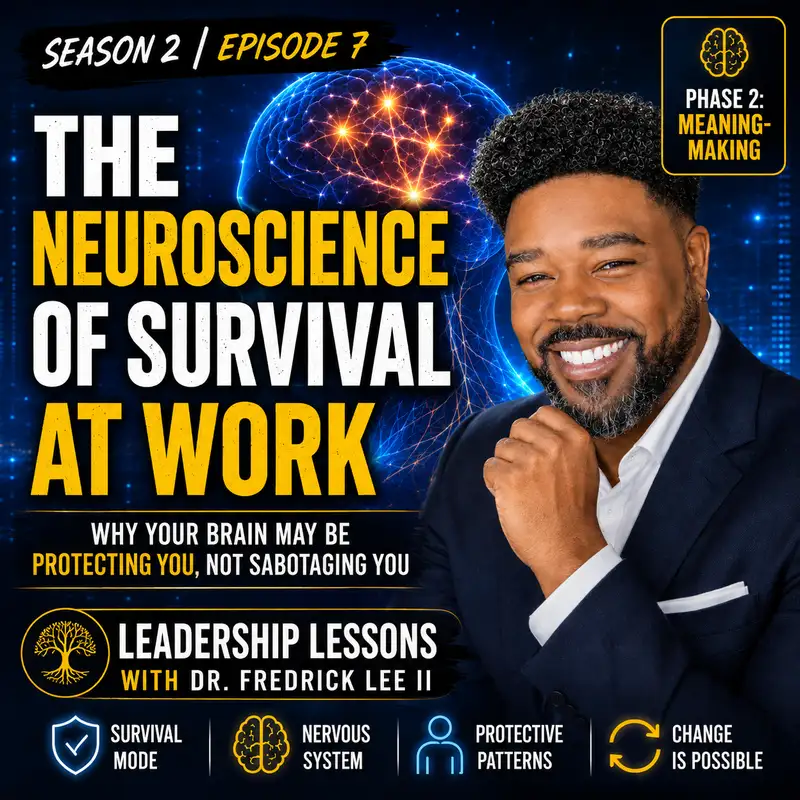
The Neuroscience of Survival at Work
The Neuroscience of Survival at Work
Season 2, Episode 7 | Phase 2: Meaning-Making — “Now I Understand Why”
What if the behavior you keep criticizing in yourself is actually your nervous system trying to protect you?
Overthinking. Shutting down. People-pleasing. Perfectionism. Hypervigilance. Avoiding difficult conversations. Feeling an immediate need to explain yourself, fix the problem, or respond before you have had time to think.
At work, these behaviors can look like personality traits, poor communication, procrastination, or even resistance. But sometimes there is more happening beneath the surface.
In Episode 7 of Leadership Lessons with Dr. Fredrick Lee II, “The Neuroscience of Survival at Work,” we begin Phase 2 of Season 2: Meaning-Making — “Now I Understand Why.”
This phase moves beyond simply recognizing that something feels wrong. Now we begin examining why certain behaviors develop, what they may be protecting, and how workplace environments can reinforce survival patterns without realizing it.
Dr. Lee explores how the nervous system responds to perceived threat through familiar survival responses such as fight, flight, freeze, and fawn, and why those responses do not always look dramatic.
Sometimes survival at work looks like staying quiet in a meeting even though you have something important to say.
Sometimes it looks like rewriting an email ten times because criticism feels dangerous.
Sometimes it is saying yes when you want to say no.
Sometimes it is preparing for every possible outcome because uncertainty feels harder to tolerate than exhaustion.
And sometimes it is appearing completely calm and capable while your nervous system is working overtime beneath the surface.
Drawing from emotional intelligence, applied neuroscience, organizational change, and his own experience with neurodivergence, Dr. Lee examines the difference between understanding a protective behavior and excusing it.
The goal is not to label every uncomfortable workplace experience as trauma or treat every reaction as healthy.
The goal is to become curious enough to ask a better question.
Instead of:
“What is wrong with me?”
Try asking:
“What is my system trying to protect me from?”
In this episode, you will learn how to identify your most common workplace survival pattern, examine the trigger and cost of that response, and distinguish between a threat that is happening now and a situation that simply feels familiar.
You will also learn the PAUSE Map:
Pause. Acknowledge. Understand. Separate. Execute.
This practical framework can help create space between an automatic protective response and the behavior you ultimately choose.
But this conversation does not stop with the individual.
Leaders and organizations have a responsibility too.
Clear expectations, predictable communication, written priorities, protected focus time, appropriate accommodations, consistent accountability, and psychologically safer responses to mistakes and disagreement can all change what employees' nervous systems learn about the workplace.
Dr. Lee challenges leaders to conduct a simple Safety Cue Audit by asking:
- What happens here when someone makes a mistake?
- What happens here when someone disagrees with a leader?
- What happens here when someone brings bad news?
Then listen carefully.
Because the real culture of an organization is not found only in the written policy.
It is found in what people have learned will happen when they tell the truth.
Trust develops when people repeatedly receive evidence that honesty, disagreement, mistakes, questions, and uncertainty can be handled without humiliation, retaliation, or unnecessary threat.
Your protective patterns may make sense.
They may even have helped you succeed.
But understanding why they developed gives you something survival mode often takes away:
choice.
Watch or listen to “The Neuroscience of Survival at Work,” subscribe to Leadership Lessons with Dr. Fredrick Lee II, and join the conversation.
Which workplace survival response shows up most often for you: fight, flight, freeze, or fawn?
Share your answer and what you are beginning to understand about it.
Leadership Lessons with Dr. Fredrick Lee II explores emotional intelligence, neuroscience, workplace culture, leadership behavior, organizational change, burnout, psychological safety, boundaries, neurodivergence, and the human side of sustainable change.
Season 2: EMPOWERED — The Inner Work of Sustainable Change
Phase 2: Meaning-Making — “Now I Understand Why”
EMPOWERED by Analyzing Toxic Behavior