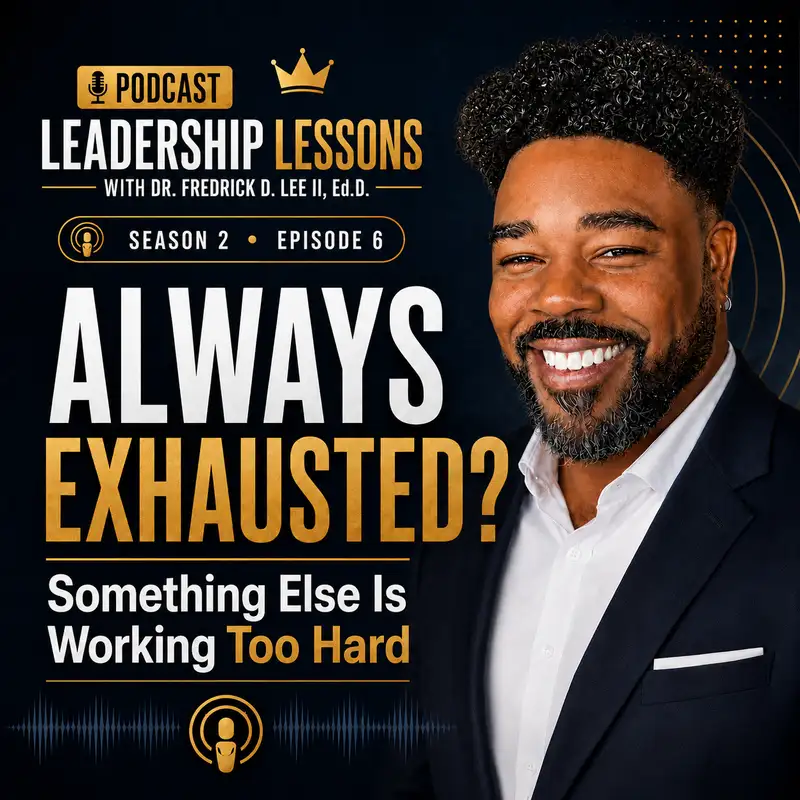
If You’re Always Exhausted, Something Else Is Working Too Hard
Mr. Change (00:57.72)
There have been days when I woke up tired before the day had even asked me for anything. I had slept. I had not run a marathon. Nothing dramatic had happened overnight. Still, before my feet touched the floor, my mind was already working. What needs to get done today? Who's waiting on me? What did I forget? Which conversation needs to be handled carefully?
What could go wrong? How much energy will it take to look calm while I figure all of that out?
Mr. Change (01:33.09)
By the time I answered the first email, it felt like my brain had already held a staff meeting without me.
That's a hard kind of exhaustion to explain because from the outside, you may still look highly functional. You show up, you leave the meeting, you remember the details, you solve the problem, you respond it professionally, you take care of people, you meet the deadline, you may even make somebody laugh while doing it. Then you get home.
And you sit in the car for 10 minutes because walking into the house feels like one more transition your system has to manage.
I know that experience personally because see, Dr. Frederick Lee, they see the degrees, the credentials, the leadership role, the change management work, and the polished presentation. All of that is real.
What they do not automatically see is the internal labor required to keep that version of me available.
Mr. Change (02:48.054)
See, I'm an introvert. My life also includes anxiety, depression, OCD, ADHD. I have spent years learning how to function, achieve, lead, and connect while managing a brain that can be brilliant, fast, creative, persistent, distracted, overloaded, hyper focused, doubtful, and tired. Sometimes all within the same 60 seconds.
So for a long time, I treated the exhaustion like a character flaw. I thought I needed more discipline, better time management, a stronger morning routine, another planner, another system, perhaps another degree. Because apparently that was my answer to several things. What I did not understand was that the visible task was only part of the work. Something else was working too hard.
My attention, my nervous system, perfectionism, and the need to anticipate problems were all working too hard. So was my ability to translate myself into whatever the room needed. That is where today's conversation begins. Not simply, why am I tired? A better question is.
What has been working overtime inside me just to make my life look normal from the outside? Stay with me through the end of this episode because I am walking.
Stay with me through the end of this episode because I am going to walk you through a practical exhaustion audit. More than that, I'm going to challenge you to give some of your energy back to yourself this week. If you have ever looked capable while privately feeling depleted, place this phrase in the comments right now. Functioning is not the same as being well. Let's get into it.
Mr. Change (04:59.5)
Welcome to Leadership Lessons. I am Dr. Frederick Lee, the second change practitioner, and I teach you how to use emotional intelligence, applied neuroscience, and change management to understand the human side of change at work, in life, and in relationships. This is season two. We're calling it Empowered, the Inner Work of Sustainable Change. And today's episode is titled, If You're Always Exhausted.
Something else is working too hard. Before we go deeper, follow or subscribe so you can move through this season in order. I want you to share this episode with the person you know who keeps saying, I am just tired, even though both you and I know the sentence is carrying more than sleep.
Mr. Change (05:55.074)
Before we go deeper, follow or subscribe so you can move through this season in order. Share this episode with the person who keeps telling you, I'm just tired and you know better.
This season began with awareness. That is the stage where
This season began with an air.
Mr. Change (06:21.41)
This season began with awareness. That is the stage where your life may still be functioning, but something inside you is starting to say this cannot be the whole story. Earlier, we examined why high-functioning performers stay in harmful environments. We named burnout as a system signal. In this episode, in the last episode, we explored the cost of silence.
And what happens when honesty no longer feels safe? Exhaustion is often what comes next. Silence takes energy. Hypervigilance takes energy. Performing wellness takes energy. Replaying conversations takes energy. Managing everybody's expectations while ignoring your own limits takes energy.
See, the body keeps an accounting system even when the calendar does not. A blank evening on your schedule does not mean your system is resting. You could be lying on the couch while your mind is preparing for tomorrow, reviewing yesterday, monitoring someone's mood, checking whether you forgot something, and criticizing you for not relaxing correctly.
That is not rest. That's unpaid overtime happening inside your body. Online, people are using phrases such as quiet burnout, high functioning exhaustion, mental load, masking, and functional freeze. These are not all clinical diagnoses. But the language is trying to capture something real. People are still producing while losing their ability to recover.
And that distinction matters. You can still be performing and already be in trouble.
Mr. Change (08:52.462)
Here's the central idea for this episode. Your visible workload is not your total workload. Hear me out. Most people count what they can. Most people count what can be seen, the meetings, the projects, the children, the deadlines, the errands, the classes, the appointments, the chores. Those demands are all real, but they do not include the background processes required to complete them.
Think about a computer with dozens of tabs open. You may only be looking at one tab, yet every tab in the background is still using memory and draining the battery. Unprocessed stress can work that same way. So can unresolved conflict, anxiety, grief, sensory overload, shame, perfectionism, people pleasing, executive dysfunction, and the constant effort to prevent disappointment.
The tab may not be on the screen, but it is still running. One tab is replaying the meeting. Another is tracking the tone of a text message. The third is reminding you that you need to schedule an appointment. Somewhere in the background, you've got a tab open asking whether people are upset with you. Another is predicting everything that could wrong. Another is predicting everything that could go wrong while one has been buffering since childhood.
Then somebody asks you why you're tired. Because technically you only completed three things today. The problem is not always the three things. The problem may be the 37 processes running behind them. See.
My ADHD can make an ordinary task require more active management than people realize. Starting, sequencing, shifting attention, estimating time, filtering distraction, and remembering where I put the thing I was holding 30 seconds ago can become a full production. Having OCD can add another layer of checking, doubt.
Mr. Change (11:05.578)
Mental review or the pressure to feel completely certain before moving on. Anxiety tries to protect me by scanning ahead. Depression can make available energy feel smaller. Introversion means social interaction and stimulation may require real recovery, even when I enjoyed the people who were involved. None of that means I am incapable.
It means capability can have a cost. High functioning people are often praised for the output while nobody asks about the overhead. Eventually, the person may stop asking to.
Mr. Change (11:58.04)
So why does this matter? Well, at work, hidden labor often looks like preparation that no one notices, right? A leader walks into a meeting and appears calm. What the people in the room may not see is the hour before that was spent anticipating reactions, choosing words, rehearsing what to say.
Organizing details, managing anxiety, and preparing three backup plans just in case the conversation shifts.
Mr. Change (12:35.512)
See, a neurodivergent employee completes the assignment. The manager sees a finished product. They may not see the alarms, the lists, the self-talk, the body doubling, the late night hyperfocus, the meals that were skipped, the sensory recovery or shame spiral that made completion possible.
Mr. Change (13:00.418)
A healthcare worker may look composed while processing all the alarms, the interruptions, the urgency, the staffing pressure, and the knowledge that a small mistake could matter. Competence can be camouflage. The same pattern can show up at home. So you have one partner who remembers appointments.
Tracks what the household needs, monitors the emotional temperature, and keeps everybody else's life moving. A visible chore may take 10 minutes. Responsibility for remembering it never clocks out. In your friendship dynamics, thoughtfulness can quietly become responsibility for the whole relationship.
Family systems add another load to this equation. Some people enter a room and relax. Others read faces, measure tone, avoid certain subjects, and decide which version of themselves will keep everyone comfortable. That kind of monitoring can happen so quickly that you do not call it work. Your but your body does.
See, that kind of monitoring can happen so quickly that you don't call it work, but your body does.
Mr. Change (14:30.432)
I have had to confront how often I confused being prepared with being safe.
Preparation is useful. I believe in preparation. I lead complex work and people deserve thoughtful leadership. The problem begins when preparation becomes an attempt to eliminate every possible uncertainty. See, now at that point, the work is no longer only planning, it is fear wearing a project management badge.
I can laugh at that now because I know it all too well. I once believed that if I anticipated, achieved, learned, and performed enough, I could finally relax.
Here's the problem with that logic. The finish line kept moving. Each accomplishment became another standard to maintain. The doctorate did not make my brain stop being my brain. The certifications did not cancel the anxiety. Leadership experience did not remove the need for recovery.
See, achievement gave me tools, options, and opportunities. It did not make me exempt from being human. That is why this episode matters. Many of us are trying to solve exhaustion by becoming more efficient at the very patterns that are exhausting us. We buy a better planner. So we can carry too much more neatly. We schedule around the boundary. We refuse to.
Mr. Change (16:17.304)
To set and turn self-care into another performance metric, then we wonder why the color-coded calendar has not healed us.
Mr. Change (16:46.006)
Applied neuroscience gives us language for part of this experience. The brain constantly decides what deserves attention, what may be dangerous, what must be remembered, and what can be ignored. So when life feels unpredictable or overloaded, more resources go towards monitoring and protection. That process is adaptive in the short term. It helps you to respond.
Over time, adaption has a cost. Researchers use the term allostatic load to describe the wear that can accumulate when the body repeatedly adjusts to stress. I think it as the bill for staying ready too long. See, your system can keep the lights on, it may keep them on by borrowing energy from your recovery, from your concentration.
from your patience, from your sleep, digestion, creativity, connection.
It's got to come from somewhere. Eventually the body begins to start sending you signals, right? Because you're taking from what's needed and giving the energy into the stress. So now you have brain fog. Now you have irritability. Now you have numbness. Now you have trouble initiating simple tasks, a lower tolerance for noise, interruption, or social demands. You need an entire day to recover from a normal week.
Feeling overwhelmed by choices that used to be easy. I know this because I live this. None of those experiences proves one specific diagnosis. See, persistent exhaustion can have medical, psychological, environmental, or combined causes. And it deserves professional attention when it is ongoing or worsening. See, just listening to this podcast cannot determine.
Mr. Change (18:52.182)
The cause of your exhaustion. But what we can do is stop treating the signal as a normal. But what we can do is stop treating the signal as a moral failure. For neurodivergent people, masking can add another invisible demand. Masking means monitoring or
Suppressing natural responses so you can appear more acceptable, organized, calm, social, or typical in a particular environment. So for me, that can mean managing my facial expressions, managing my tone, my pacing, my attention, my movement, and how much detail that I share. I may look fully present.
While my mind is juggling several streams of information, careful not to reveal how much effort the interaction is taking. That's masking. Masking may protect belonging, opportunity, reputation, or safety. It can also be exhausting. The difficult part is successful masking hides the evidence. People see that you handled it. You know what the cost was.
The difference can create shame. You may compare your recovery needs to someone else's visible workload and decide you are weak. A more accurate question is, what did my system have to manage that nobody else could see?
Emotional intelligence begins there. Self-awareness is not judging the signal, it's noticing it accurately. Change management offers another lesson. When an organization has a performance problem, a responsible practitioner does not immediately blame the employee. We examine the process, the environment, the tools, the workload, the barriers.
Mr. Change (20:59.446)
And competing demands. Yet many of us as leaders refuse to conduct that same analysis on our own lives.
We'll call ourselves lazy before reviewing the system. We demand more motivation without reducing the friction. We treat a capacity problem like an attitude problem. That is poor change management, even when the organization is you.
Mr. Change (21:36.33)
Now for the truth-telling moment.
You may not be exhausted because you are doing too little poorly. You may be exhausted because too many parts of you are working constantly to keep everything from falling apart. There is a difference. See, one version may need discipline, the other may need relief, support, redesign, treatment, barriers, accommodation. See where I'm going?
Honesty or rest. Several may be needed at once. Another truth is harder. Being needed can become part of your identity. When you're the reliable one, slowing down can feel threatening. What happens if people see the effort or feel disappointed?
Who are you when you are not performing usefulness? Those questions have required honesty from me. There is pride in being capable. There is also danger in making capability the only version of yourself worthy of respect. You can't always be at your best. Otherwise, it wouldn't be called your best. It would be your normal.
If your best is required every single day, then your life is not asking for excellence.
Mr. Change (23:14.816)
It is financing performance with future energy. Sooner or later, somebody's gotta pay the bill.
Mr. Change (23:24.376)
This is where self compassion becomes practical, not sentimental. Healing is not only learning to admire the strongest version of yourself. Healing also means caring for the version that can't keep up today. The overwhelmed version still deserves food. Distraction still deserves patience. Needing quiet does not make you anti social.
Being unable to answer one more message does not make you ungrateful. Asking for help does not mean you failed leadership. That person is part of you too.
Mr. Change (24:08.12)
So let's turn this into something you can use. Start by separating visible work from hidden work. Imagine you have a presentation tomorrow.
The visible task is creating the the creating and delivering the presentation. Hidden work may be worrying about how you'll be perceived, revising one more slide 15 times. It's it's anticipating every possible question that could be asked. It's rehearsing your transitions from you know one section to the next.
Checking the technology repeatedly, monitoring the room and replaying the presentation afterwards.
The presentation may last thirty minutes.
But your nervous system may have been working on it for three days.
Mr. Change (25:06.614)
At home, the visible task might be cooking dinner. The hidden work includes deciding what everyone will eat, checking supplies, timing the meal, noticing who seems upset, and thinking about the next responsibility.
In relationships, the visible task is a conversation. The hidden work may involve rehearsing the sentence, predicting the reaction, softening every word, deciding whether your need is reasonable, and preparing to comfort the other person for being affected by the truth you needed to tell.
Mr. Change (25:47.722)
No wonder the conversation is tiring before it starts. Leaders need to look for this on Teams too. Ask your employees what part of this work requires more energy than it should? See, that question is better than assuming the workload can be measured by task count alone. Two assignments can require different levels of cognitive switching, emotional labor, ambiguity, and coordination.
A sustainable workplace reduces unnecessary overhead. There are clear priorities reducing the guessing. There are written instructions reducing work memory demands. Predictable processes reduce threat monitoring. Protected focus time reduces context switching. Psychological safety reduces the energy spent editing the truth.
Mr. Change (26:45.558)
In your personal life, redesign may look smaller, but it still matters.
So place recovery time after a high stimulation event instead of pretending the transition is free. Turn off notifications that recruit your attention all day. Use written reminders rather than forcing your brain to keep everything active. Ask for the agenda. Choose the simpler meal. Let a text wait.
Clarify the expectation instead of imagining six possible ones. Tell someone I want to be present and I need a little time to reset first. What's wrong with that? Support is not cheating. Structure is not weakness. Accommodation is not an unfair advantage. It's a way of removing unnecessary barriers so capacity can be used where it matters.
Mr. Change (27:59.724)
Here are five things you can do this week. First, complete the background process audit. This is what you do. Take one sheet of paper and create two columns. On the left, write what I did. On the right, write what it took.
Mr. Change (28:22.21)
Do not stop just at the task. Name the preparation part, the regulation part, the sensory management, the checking, the remembering, the avoidance, the recovery involved. What did you go through?
Mr. Change (28:40.034)
the bottom okay when you finish your list at the bottom you're gonna finish this sentence this part of my life working too hard is
Mr. Change (28:57.676)
The part of my life working too hard is finish that sentence. Your answer may be attention, it may be your nervous system, it may be perfectionism, caretaking, image management, or the constant effort to avoid someone's disappointment. But it's based on that list.
Mr. Change (29:23.208)
Next second, try the one hundred pennies exercise. And yes, you can use pennies. Gotta use them for something.
Mr. Change (29:40.492)
Use pennies, note setting on your phone, or y y you can make a hundred, you know, marks on a piece of paper.
Each time you spend emotional energy on something or someone, move or mark the amount that feels accurate.
A tense meeting may cost you 10 pennies. Replaying it for two hours may cost another 20. Helping a friend may feel meaningful and still cost you five pennies. Checking on everybody while refusing to check on yourself may empty your pocket. The goal is not to become selfish. The goal is to make invisible spending visible. Third.
Stop making completion the entire
Stop making completion the entry fee for self-respect.
Mr. Change (30:41.454)
Choose one task and use this reframe. Your job is to start, not finish. Open the document, start washing five dishes, answer one part of the email, put the appointment request in the porter, just get it started, work for 10 minutes.
See, momentum begins when the perfection is removed from the doorway.
Mr. Change (31:14.178)
The fourth redesign.
One recurring source of friction.
Fourth, redesign one recurring source of friction. Do not create a complete life overhaul. Just pick one thing that drains you repeatedly.
It could be
meeting that becomes a meeting become an email could a meeting be an email pick one thing that drains you repeatedly could a meeting become an email could an agenda arrive earlier could one responsibility be delegated could you create a quiet transition after work stop absorbing the task everyone assigns you
Mr. Change (32:12.374)
Request a reasonable accommodation. Or speak with a clinician, a therapist, a coach, or a trusted support person. See, small redesign matters because exhaustion is often produced by repetition. The fifth thing.
Begin the seventh day energy return. So for the next seven days, reclaim one small piece of energy every single day. Cancel one unnecessary obligation.
Allow one thing to be good enough.
Take one quiet break without earning it first.
Ask one person for help. Now that one may be hard. That wouldn't be hard. That would be hard for me. It is, but I'm I'm gonna do it too. That's that's the one that I would do. Ask one person for help.
Mr. Change (33:18.584)
Tell an honest sentence.
Mr. Change (33:24.738)
Don't wait for a dramatic transformation, right? Sustainable change often begins with a small interruption in an old pattern.
Mr. Change (33:39.456)
As we close, I want you to think about the version of you other people see, the dependable version, the accomplished version, the person who gets it done. Now think about the unseen team working behind that person. The part scanning for danger and checking for mistakes, the part managing everyone's comfort and remembering what cannot be forgotten.
The part hiding the overwhelm while pushing through because people are counting on you. Those parts may have helped you survive, succeed, lead, and belong. They are not enemies. They may simply be overworked. Before you demand more from yourself, ask whether some part of you needs to be relieved of duty.
Remember, functioning is not the same as being well. Productivity is not proof of peace, and competence does not erase capacity limits. Rest is not only stopping activity, rest is reducing the amount of things your system believes it must keep managing. So the deeper invitation is this.
Do not spend the week trying to become a more efficient machine. Become a more honest steward of your energy. Notice what drains you before the task begins. Pay attention to where you perform calm. Carry the emotion. Notice what drains you before the task begins. Pay attention to where you perform calm, carry the emotional clipboard.
Or ignore the body telling you the workload is larger than it looks. Then change one thing. Not someday, this week. Complete the background process audit. Try the 10 pennies and reclaim one piece of energy for seven days. Then come back and share one sentence in the comments. I found the hidden work and I'm changing.
Mr. Change (35:59.682)
Finish. Tell us what you're changing. I found the hidden work and I'm changing. Complete that sentence in your own words. Your response may help someone else recognize what they carry and become a public commitment to your own restoration. I want you to follow or subscribe so you can continue through season two's journey. Share this episode with a high performer who looks fine and keeps disappearing to recover.
Like this episode, but do not let engagement be the only action you take. Close a tab. Set a boundary. Ask for clarity. Schedule the appointment.
Personally ask yourself, what would change if I stopped treating exhaustion as proof that I need to try harder? For those of you ready to go deeper, this is the work we explore through coaching, emotional intelligence development, leadership development, and organizational change support. We examine the person and the system because sustainable change requires both. You don't need to become less capable.
You need a life where capability does not require constant self-abandonment. Walk slowly in the right direction. Let recovery become part of the plan. Give yourself permission to build success that your nervous system can survive. Thank you for spending time with me today. I'm Dr. Frederick Lee II, and this has been your leadership lesson in life. Fight on.