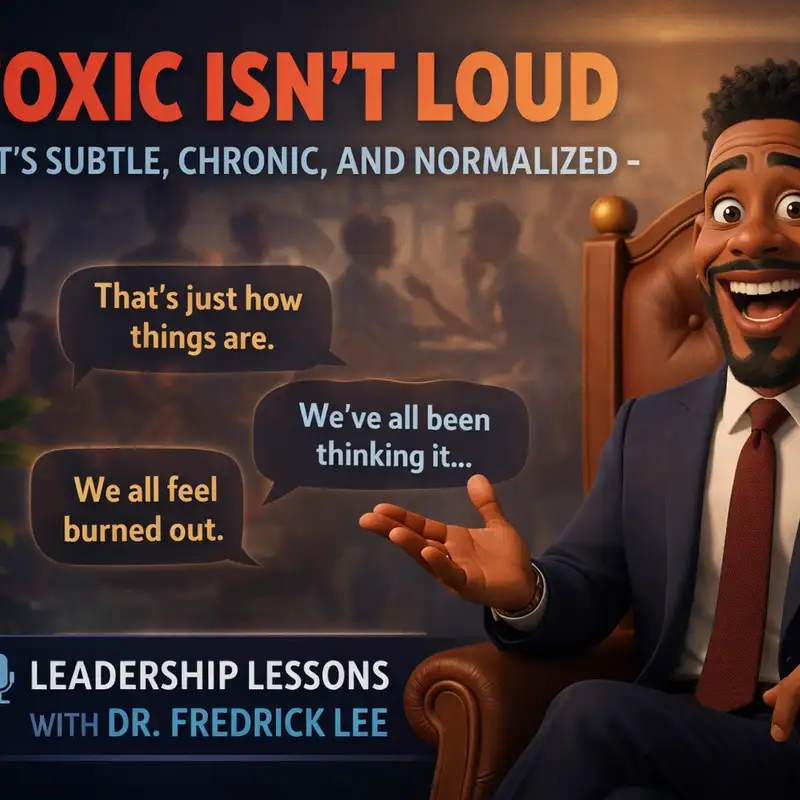
Toxic Isn't Loud - It's Subtle, Chronic, and Normalized
Mr. Change (00:00)
Sometimes the most toxic environments are not the ones with the slam
doors, the screaming boss, or the obvious public humiliation.
Sometimes toxicity is much quieter than that. It sounds like that's
just how it is here. It looks like smiling through chronic exhaustion.
It feels like second guessing yourself after every meeting.
Even when nobody said anything overtly cruel, it shows up when the
room gets silent after someone tells the truth. It shows up when the
highest performing people are the most depleted. It shows up when your
body starts dreading spaces your mind is still trying to defend. And
this is what makes subtle toxicity so dangerous. Because
If it is not loud, we often don't name it. If it is chronic, we start
adapting to it. And if it is normalized, we start calling it culture.
So today, I wanna talk about that. I wanna talk about the kind of
toxic dynamic that does not always announce itself, but slowly shapes
behavior, emotions, leadership, and systems in ways that make
Sustainable change feel almost impossible. Because change does not
usually fail because people do not care. It fails because behavior,
emotions, and systems are misaligned. And if we do not learn how to
recognize that misalignment, we will keep trying to fix symptoms while
living inside the pattern.
Welcome to Leadership Lessons with Dr. Fredrick Lee, and I am glad you
are here. This episode is part of season two, our Empowered series,
the inner work of sustainable change. And we are in the awareness
stage of that journey. This is the stage where many people are quietly
asking themselves, something is not right, but I do not fully know how
to explain it.
And that matters. Because awareness is where sustainable change
begins. Not performance. Not productivity. Not pretending. It's
awareness. Today's episode, Toxic Isn't Loud. It's subtle, chronic,
and normalized.
begin with a reality that so many people live with but struggle to
articulate. A lot of listeners are not struggling because they are
weak. They are struggling because they have been trying to function in
environments where emotional reality, the behavior expectations, and
the organizational systems do not match. Maybe the organization says
it values people
but rewards burnout. Maybe a leader says, my door is always open, but
every hard conversation is punished. Maybe a team says, we believe in
collaboration, but people operate in fear, silence, competition, and
self-protection. Maybe in your personal life, in your work, or even in
your ministry, nonprofit, or leadership role,
you have felt yourself shrinking, numbing, over-functioning, or
becoming someone you do not recognize. And because nothing dramatic
happened all at once, you may have questioned your own perception. You
may have thought, maybe I'm too sensitive. Maybe I just need to be
tougher. Maybe I'm overreaching. Hell, maybe I'm the problem.
Internal confusion is often one of the first indicators that something
unhealthy has become normalized. So the core problem we are addressing
today is this. People often wait for toxicity to be obvious before
they trust what they are experiencing. But by the time a dynamic
becomes obvious, the impact has already been building in the nervous
system, in relationships, in culture, and in performance for a long
time.
At end of this episode, want listeners to understand this. Toxicity is
not only about extreme behavior, it is also about repeated patterns
that distort safety, trust, dignity, clarity, and emotional reality
over time. I want you to feel less confused. I want you to feel more
grounded in what you are noticing.
want you to leave with language, perspective, and a few practical
steps you can use this week to recognize what is actually happening
around you and within you.
Because when you can name a pattern, you are no longer fully trapped
inside of it.
You may be wondering why does this matter? Well, I'm a tell you. This
matters in real life because subtle toxicity does not stay subtle in
its impact. It touches everything. It affects how people lead, how
they communicate, how they recover, how they trust, how they set
boundaries, how they make decisions, how they perform, how they attach
meaning to work, how they carry stress home.
how they show up in relationships. Yep, all the things.
And one of the hardest truths about unhealthy environments is that
people do not just work in them. They adapt to them. Let me say that
again. People do not just work in unhealthy systems. They adapt to
them. That means the person who used to speak up becomes quiet. The
person who used to be creative becomes guarded.
The person who used to be emotionally present becomes numb. The person
who used to have healthy boundaries becomes hyper-available because
they are trying to avoid conflict, punishment, or abandonment. And
leaders adapt too. Sometimes leaders begin with good intentions, but
if they are unhealed, emotionally immature, unsupported, or operating
in dysfunctional systems,
they can start managing anxiety instead of leading people.
they began avoiding truth, controlling outcomes, rewarding loyalty
over honesty, calling exhaustion commitment, calling silence
professionalism, calling compliance alignment. And see over time, a
culture can become built around survival instead of trust.
That is where burnout starts becoming more than just being tired.
Burnout is not always simply about workload. See, sometimes burnout is
the psychological and physiological cost of having to constantly
override your own reality in order to keep functioning.
when you are always reading the room, when you are managing other
people's emotions, when you are censoring yourself, when expectations
are unclear, when accountability is selective, when harm is minimized,
when the system keeps asking you to carry what it refuses to
acknowledge, that is not just hard, that is depleting at the nervous
system level. This is where...
Neuroscience helps us understand what many people have felt but could
not explain. See, the brain and the body are always scanning for cues
of safety or danger. Not just physical danger, relational danger,
emotional danger, social danger. Can I tell the truth here? Can I make
a mistake and still be respected? Can I ask a question without being
shamed? Can I disagree without being punished? Can I...
the need without being seen as a burden. Can I be human in this
environment
When the answer to those questions is consistently no, or maybe, or
only if you say it the right way to the right person at the right
time,
See, the nervous system learns instability. That instability can show
up as anxiety, hypervigilance, irritability, fatigue, self-doubt,
overthinking, emotional shutdown, people-pleasing, chronic stress. And
the tragedy is that many high-capacity people misread those signals.
They think, need better time management. I need more discipline. I
need to stop being emotional.
No. Sometimes what you are feeling is not a character flaw. is
information. It is data. Sometimes your body is telling the truth
before your mind is ready to admit it. And this matters for leadership
because toxic norms do not only harm individuals. They sabotage
change.
If you want innovation, but people do not feel safe, to be honest,
change will stall. If you want accountability, but people see double
standards, trust will erode. If you want collaboration, but people are
operating in fear, they will protect themselves before they protect
the mission. If you want sustainable results, but your culture is
built on chronic over-functioning.
If you want innovation, but people do not feel safe, to be honest,
change will stall. If you want accountability, but people see double
standards, trust will erode. If you want collaboration, but people are
operating in fear, they will protect themselves before they protect
the mission. If you want sustainable results, but your culture is
built on chronic over-functioning.
Eventually, the system will break the very people it depends on. So
whether you're an employee, a caregiver, a manager, an executive, an
entrepreneur, a ministry leader, or someone trying to heal from an
unhealthy environment, this conversation matters because recognizing
toxicity is not about becoming negative. It's about becoming honest.
And honesty is not the enemy of hope. It is the beginning of it.
So here's the truth-telling moment for this episode.
Not every difficult environment is toxic. Difficulty exists. That
doesn't mean it's toxic. Difficulty and toxicity are independent of
each other. They're not interchangeable. What you have to remember is
when difficulty becomes chronic distortion and that distortion is
normalized.
You are no longer dealing with a hard season. You are dealing with an
unhealthy pattern. See, that distinction matters because every
workplace will have stress. Every team will have conflict. You're
trying to put people together who have different ideas, who have
different backgrounds. They're going to disagree. You've got to figure
out how to disagree and still be functional and productive.
So every team will have conflict. Every leader will make mistakes.
Every organization will go through training. Toxicity is not the
presence of imperfection. Toxicity is what happens when harm becomes
the pattern. Accountability becomes inconsistent. Emotional reality
becomes denied. And people are expected to adjust to dysfunction as if
that adjustment is maturity.
That is what you have to reframe. Maturity is not silently enduring
the chronic dysfunction. No.
Maturity is the ability to notice what is true, regulate yourself
enough to stay grounded in it, and respond with clarity.
So another truth that we need to tell here is this.
A toxic culture is often held together by very ordinary behaviors. Not
dramatic abuse. It's ordinary behaviors. Let me give you some
examples, because I don't think y'all believe me. Ordinary behaviors.
Interrupting certain people consistently. You've been in a meeting.
and you are speaking, you're literally talking and someone starts
talking while you're talking. Ordinary behavior. But that's rude.
That's disrespectful to the person who is still speaking. It's also
disrespectful to the people who are actively listening, trying to
understand what the first person was saying before you took over the
moment. So, people. Rewarding urgency over wisdom.
and you are speaking, you're literally talking and someone starts
talking while you're talking. Ordinary behavior. But that's rude.
That's disrespectful to the person who is still speaking. It's also
disrespectful to the people who are actively listening, trying to
understand what the first person was saying before you took over the
moment. So, people. Rewarding urgency over wisdom.
Getting it done quickly, even though there was no thought to it. It
doesn't make any sense, but we got it done.
laughing because this is literally happening.
Ignoring emotional impact because the work come first. Effective
immediately. The memo starts with effective immediately. Yeah. Yeah.
We not gonna discuss this. We not gonna ask you for your input. We
don't care for your feedback. Starting right now, this process has
changed. Using...
ambiguity if I can talk today using ambiguity as control
Things are always vague because that's how I'm gonna keep you dancing.
That's how I'm gonna keep you doing what I need you to do or what I
want you to do.
My instructions, my direction is...
Undecernable But that's the point.
It's the organization celebrating resilience while refusing to address
what people are being resilient against.
my God, thank you so much for your service.
and then it stops right there. Nothing comes out.
It's punishing people who set boundaries by labeling them as
difficult. Not a team player or too sensitive. This is when that
person calls you, just out the blue calls you.
doesn't ask if you have time doesn't doesn't
is not trying to schedule with you, it just goes into, this is what I
need, this is what my problem is, help me fix it.
and you politely tell them you're in the middle of something? Can we
talk about this at this time tomorrow later? Because see, your urgency
is not my urgency. Right? Your urgency.
may differ. So...
Why do I have to drop everything to help you? What about-
doing something else. see, but you labeled me as difficult. Not a team
player.
Or I said no.
I said no to something that I didn't have to do. Right. So let's say
you reduced your workforce and now those of us that remain, you want
me to run all five of these departments when you got rid of these five
department heads.
say no to that. I'm not a team player. I'm too sensitive. Confusing
accessibility with lack of limits.
confusing charisma with trustworthiness.
confusing compliance with health.
And here's where emotional intelligence becomes essential. Emotional
intelligence is not just being nice. And that's what people think,
you're not agreeable, you're not being nice to me, you lack emotional
intelligence. That's not even what this is about.
It's not just about self-control. It's not just reading the room. At
its deepest level, emotional intelligence is the capacity to
accurately perceive emotion, understand what it is communicating,
regulate your response, and engage others in a way that creates
greater clarity, responsibility, and safety.
I've been told that I am emotionally unintelligent because...
communicated or expressed my frustration at work.
simply saying this is frustrating because it doesn't make any sense or
by saying
Let me be clear.
I'm sick and tired of these situations. I'm sick and tired of us being
reactive. I am sick and tired of us normalizing this dysfunction. I'm
waving a red flag that hello, something over here in this culture is
not right.
That's what has been said. well, he lacks emotional intelligence. No,
no. I know exactly what I'm feeling. I know exactly why I'm feeling
this way. I am.
communicating.
this emotion. I'm still regulating my response.
I just said I was sick and tired. I didn't flip the desk over.
That, you see what saying? That would be different.
It's about engaging others in a way that creates greater clarity,
responsibility, and safety. I am telling you exactly what I feel is
wrong from my perspective. If more people did that, it would be much
harder to ignore.
In toxic or unhealthy systems, emotional intelligence often gets
replaced by emotional adaptation. So we normalize not saying anything.
We normalize keeping that to yourself. We normalize keep your head
down. Don't rock the boat. We normalize that stuff.
Emotional adaptation says, learn how to survive in this room.
emotional adaptation. You need to do these things to survive here. I
have literally been told that.
one company, the next company, multiple times. You need to do these
things to survive here. You have to learn how to survive this room.
That's emotional adaptation. Emotional intelligence says, notice what
this room is doing to you and choose your response with awareness. So.
When I get frustrated at work and I choose to say what I say in an
email, I am choosing to do that. I know exactly what I am doing. I
know exactly how it's going to be perceived in this environment. I
know exactly what's gonna happen next.
because they don't deviate from the playbook. Right? See, I'm
difficult, I'm not a team player, I'm all of these things. No, I'm
communicating, I'm transparent, I'm emotionally intelligent. I am
telling you what this room is doing to me, and I'm choosing to bring
awareness to you.
That is different in corporate spaces. We're used to being passive
aggressive, been holding things in and just not saying it, just
keeping the status quo, keeping everybody comfortable.
No. That's not emotional intelligence. That's emotional adaptation.
Here's another truth. Psychological safety is not comfort. It is not
agreement, and it is not the absence of standards. Psychological
safety is the presence of enough trust and dignity for people to
think, speak, question, learn, and repair without fear of humiliation
or retaliation.
I can be myself in this room. I can be myself in this space. If I'm
emotionally in tune and emotionally expressive, I can do that here
without fear that it's going to affect me negatively.
Without psychological safety, organizations may still function, but
they will not function honestly. People will hold back. They'll still
perform. They will still self-protect. Look, we all still got bills,
okay? So we gon' show up, because the student loans keep coming, the
mortgages keep coming, the electric bill keeps coming. So.
Without psychological safety, organizations may still function, but
they will not function honestly. People will hold back. They'll still
perform. They will still self-protect. Look, we all still got bills,
okay? So we gon' show up, because the student loans keep coming, the
mortgages keep coming, the electric bill keeps coming. So.
they'll still perform, they'll still self-protect, right? They have
kids in college and medical bills and all this other stuff. They will
still say what is safe instead of what is true because I need this
job, I need this paycheck. So, emotional adaptation.
So now you have a system that is becoming disconnected from reality.
People are going into work numb to what's really going on. That is why
sustainable change fails so often. People, these companies launch
initiatives and these trainings and these value statements and this
culture campaign and these strategic plans, but the underlying
emotional and behavior system remains unchanged. You did nothing to
address the environment.
You can teach people how to communicate, but if the room is filled
with fear, people still won't say anything.
You can announce all the wellness initiatives and all have all the
happy healthy workforce luncheons.
But if everybody is still exhausted, what's really happening?
You can say all the right things, right? Bring your whole self to
work. But the moment somebody shows vulnerability, they get penalized.
So now people are going to bring a version of themselves that feels
safest to protect. The work me. This is how I am at work. My work life
and per- I'm a different person now, so. All of that. That means you
work in a toxic environment.
So let me offer this clearly.
Change does not fail because people do not care. It fails because
behavior, emotions, and systems are misaligned. That means the stated
values and the lived experience do not match. The leadership language
and the leadership behavior do not match. The call for innovation and
the punishment of honesty do not match. The desire for healing and the
refusal to face patterns do not match.
And when there is a chronic mismatch, people become exhausted, not
only by what they are doing, but by what they are constantly having to
reconcile inside themselves. That internal reconciliation is costly.
It's costly emotionally, it's costly mentally, it is costly
relationally, and eventually, it is costly organizationally.
So if you've been feeling like something is off but you could not
prove it because it did not look dramatic enough, I want to say this
with care. You do not have to wait for a system to become catastrophic
before you trust what is costing you. See, awareness is not
overreaction. Awareness is information. And information gives you the
possibility of choice.
So if you've been feeling like something is off but you could not
prove it because it did not look dramatic enough, I want to say this
with care. You do not have to wait for a system to become catastrophic
before you trust what is costing you. See, awareness is not
overreaction. Awareness is information. And information gives you the
possibility of choice.
So, okay, so we got toxicity going on here. what does this look like
in real life? What do you actually do with this if you are in the
awareness stage? If you are waking up to what is going on within your
organization, what your true culture, where culture is. Because at
this stage, the self-awareness stage,
This is very important because awareness is not the stage for
impulsive decisions. It is not the stage for blowing everything up.
This is not where you go in with the wigs and sunglasses and set it
off. It is not the stage for shaming yourself, for not leaving sooner,
speaking sooner or seeing it sooner. well, why did not I should have?
done with that. This is the stage for noticing clearly. This is the
stage for telling yourself the truth gently but accurately. See this
is the stage for reducing confusion.
And this is the stage for beginning to separate what is yours from
what belongs to the environment, what belongs to leadership, what's
part of the culture, what's the system.
Okay? In other words, the things that are within your control and the
things that are not. So, let me say it this way. If you are in a
workplace,
Maybe you notice that after every team meeting you feel heavy, tense,
or unusually small.
If you are in a leadership role, maybe you notice that your team
agrees with you publicly, but brings concerns privately. Or they talk
amongst themselves about the issues that they have.
If you're in a family system or community dynamic, maybe you notice
that honesty always gets redirected into blame, minimization, or
silence. If you're trying to make a healthy change in your own life,
maybe you notice that every time you start honoring your limits, guilt
rushes in as if rest is betrayal.
These are not random reactions, these are signals. And in this
readiness stage, this awareness stage, the goal is not to judge the
signal too quickly. The goal is to become curious enough to understand
it. I'm recognizing it. What does this mean?
So here are a few things that you can do this week.
Start by naming recurring patterns, not isolated moments. One rude
comment may be a bad moment. A pattern of dismissal, confusion,
unpredictability, or emotional invalidation is different. So ask
yourself, what keeps happening here? What is repeated? What feels
normal here that should not feel normal?
Start by naming recurring patterns, not isolated moments. One rude
comment may be a bad moment. A pattern of dismissal, confusion,
unpredictability, or emotional invalidation is different. So ask
yourself, what keeps happening here? What is repeated? What feels
normal here that should not feel normal?
Pay attention to whether the issue is occasional friction or chronic
distortion. That distinction matters. So you have to pay attention to
your body before you talk yourself out of what you feel. Do you brace
before certain conversations? Do you feel drained after interactions
that look harmless on the surface? Do you over-prepare because you
have all this uncertainty or unpreparedness?
predictability in your environment, which is making you feel unsafe.
Do you feel relief when a certain person is absent?
See, your nervous system is not always giving you the whole story, but
it is often giving you important information. Do not ignore it. In
this stage, you want to interpret it. Ask yourself, what is being
rewarded in this organizational system? This is a powerful question.
Not what the organization says it values. What does it actually
reward? Does it reward honesty?
or image management? Does it reward healthy boundaries or
overextension? Does it reward collaboration or quiet compliance? Do
you see where we're going? Does it reward reflection or constant
urgency? Everything is urgent!
Culture is not built by these posters that they put up on the wall,
it's not the website or your catchy mission statement. Culture is
built by what gets reinforced. What are the people doing?
So if you wanna understand whether something is healthy, watch what
gets protected, what gets praised, what gets excused, or repeated.
Notice whether your self-trust has eroded. See, subtle toxicity often
attacks self-trust before it attacks anything else.
You start explaining away your discomfort. You start minimizing what
you know. You start needing excessive validation before you believe
your own experience. So ask, where have I been overriding myself?
Where do I know more than I have been allowing myself to admit?
What have I normalized just to keep functioning? Those are awareness
questions, not shame questions, awareness questions.
Practice one small boundary of observation, not accusation. In this
awareness stage, boundaries do not have to be dramatic. Sometimes the
first boundary is simply refusing to automatically internalize
everything. Sometimes it's pausing before saying yes. Sometimes it's
just documenting the past.
Sometimes it's limiting unnecessary emotional labor.
Sometimes it's you saying, need time to think about that.
Sometimes it's deciding that every uncomfortable reaction you feel is
not immediate evidence that you have done something wrong. That's a
boundary too. A boundary is not just what you say to other people, it
is also what you stop saying to yourself.
Now, for those of you who lead others, let me say it this way.
Do not only ask whether your team is productive. Ask whether your team
is safe enough to be honest. Do people tell the truth in the room? Or
only after the meeting? Do people raise concerns early or only when
things are already falling apart? Do your standards create growth or
chronic fear?
Do people experience your accountability as clarity or as
unpredictability? Are you leading from vision or from your own
unprocessed anxiety? See, that last one is important because leaders
can unintentionally normalize toxicity when they have not done their
own inner work. When leaders are disconnected from their own emotions,
they often become reactive, avoidant, defensive.
or controlling without fully realizing it. And then the system starts
organizing itself around that unexamined emotional pattern. So if you
lead, this episode is not just about what has happened to you. It is
also about what may be moving through you into the culture around you.
That is why sustainable change always requires inner work, not just
strategy, not just structure.
inner work. Because systems are shaped by patterns and patterns are
carried by people. Let me summarize the action steps in a simple way.
Here are five clear action steps you can apply immediately this week.
Number one, start by tracking patterns for seven days. Just write down
moments when you feel dismissed, confused, tense, silenced, or
emotionally drained. Look for repetition.
not perfection. Number two, pay attention to your body's cues in real
time. Notice when your shoulders tighten, your breathing changes, your
thoughts race, or your energy drops. Treat those reactions as
information to explore. Number three, ask yourself one culture
question every day. What gets rewarded here?
Let the answer show you whether the system is aligned with its stated
values. Number four, identify one place where you have been overriding
your own reality. Maybe it's minimizing your fatigue. Maybe it's
excusing disrespect. Maybe it's calling chronic anxiety just stress.
Name it clearly. And number five, practice one small boundary this
week. Pause before overcommitting.
Delay a response. Step back from unnecessary emotional labor. Give
yourself permission to observe without immediately fixing everything.
That is enough for this week. Because awareness work is not about
doing everything at once. It's about becoming honest enough to stop
participating unconsciously in what is harming you. And for many of
you, that is a profound beginning.
Delay a response. Step back from unnecessary emotional labor. Give
yourself permission to observe without immediately fixing everything.
That is enough for this week. Because awareness work is not about
doing everything at once. It's about becoming honest enough to stop
participating unconsciously in what is harming you. And for many of
you, that is a profound beginning.
As we close, I want to leave you with this reflection. Not everything
unhealthy in your life will arrive with dramatic language and obvious
warning signs. Some of it will arrive as chronic tension, as
confusion, as emotional exhaustion, as silence, as self-doubt,
normalization. And because it's subtle, you may be tempted to dismiss
it.
Please don't dismiss what your mind, body, and spirit have been trying
to tell you. Listen carefully. The awareness stage is sacred work.
It's the stage where you stop calling dysfunction normal. It's the
stage where you stop interpreting your depletion only as weakness. It
is the stage where you begin to understand that what you are feeling
may not simply be about your capacity, but about the environment, the
leadership, the system.
and the emotional pattern you've been carrying. And that understanding
matters because once you can name a pattern, you can respond to it
more wisely. You can protect your energy more intentionally. You can
lead more honestly. You can build healthier boundaries. You can create
more psychologically safe spaces. And you can participate in change
that is not just performative, but sustainable. That's the invitation
of this season.
not just to change what you do, but to understand what has been
shaping how you do it. So this week, I want you to slow down just
enough to notice. Notice what feels off. Notice what has become
normal. Notice what your body is saying. Notice what the system
rewards. Notice where your self-trust needs to be rebuilt.
You don't have to solve it all this week, but you do need to stop
abandoning your own awareness. And if this episode resonates with you,
if you are recognizing unhealthy patterns in your leadership, your
workplace, your relationships, or your own internal habits, this may
be the right time to do deeper work. Whether that looks like coaching,
emotional intelligence development, leadership formation, or support
around sustaining
personal or organizational change. Do not underestimate what becomes
possible when awareness is paired with intentional growth. Sometimes
the most powerful next step is not doing more. It is seeing more
clearly. And from that, clarity is where you gain
the ability to choose differently. Thank you for spending this time
with me. I am Dr. Fredrick Lee II, and this has been your leadership
lesson.
the ability to choose differently. Thank you for spending this time
with me. I am Dr. Fredrick Lee II, and this has been your leadership
lesson.