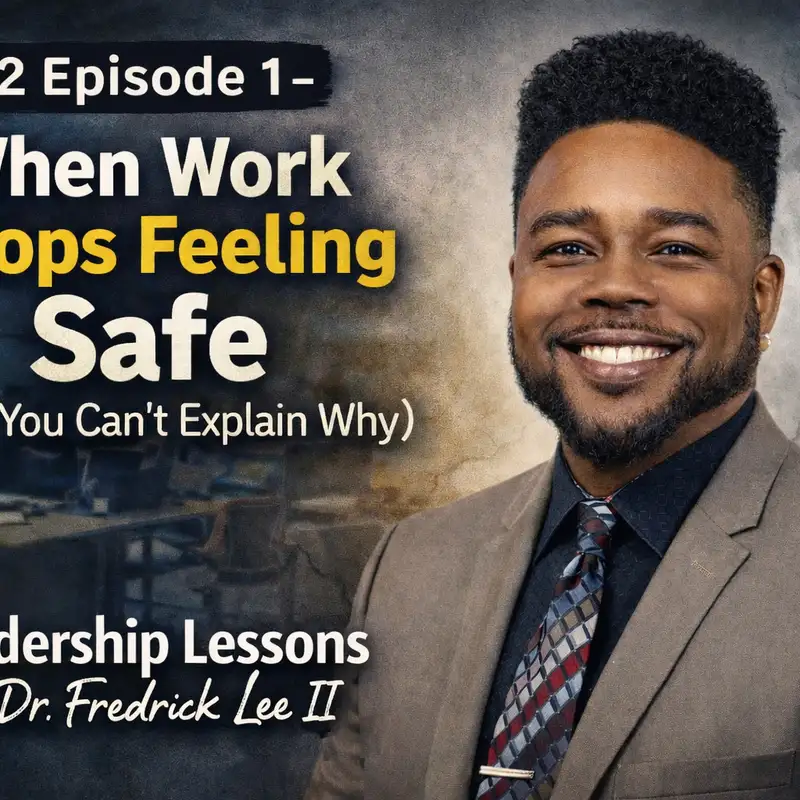
When Work Stops Feeling Safe (But You Can't Explain Why) | Psychological Safety at Work
There’s a moment many people experience at work that’s hard to explain.
Nothing has technically gone wrong.
You’re still doing your job.
Still meeting expectations.
Still showing up.
But something feels different.
You hesitate before you speak in meetings.
You rewrite emails more than you used to.
You replay conversations in your head long after the workday ends.
And when you try to explain it to someone else, you struggle to find the words—because there’s no single incident you can point to and say, “That’s when it changed.”
If that sounds familiar, I want you to know something right away:
You are not imagining it.
And you are not alone.
SECTION 1: WELCOME + SEASON 2 CONTEXT
Welcome to Season 2 of Leadership Lessons.
Season 1 focused on leadership insights—what leaders should do, think about, and improve.
Season 2 goes underneath that.
This season is about what happens inside people as they navigate constant change, rising expectations, shrinking capacity, and systems that often demand resilience without providing support.
This season is grounded in the work from my book, EmpowerED, which centers one core truth:
Change doesn’t fail because people don’t care.
It fails because behavior, emotions, and systems are misaligned.
And when those things are misaligned long enough, people start to feel unsafe—without always knowing why.
SECTION 2: THE SEASON ARC (SET EXPECTATIONS)
This season includes 25 episodes, and they are intentionally sequenced.
We move through five readiness stages:
First, Awareness — realizing something isn’t right.
Then, Meaning-making — understanding why patterns exist.
Then, Behavior and Boundaries — learning how to respond differently.
Then, Systems and Sustainability — recognizing that personal growth fails without structural support.
And finally, Invitation and Integration — deciding what kind of support is needed next.
Episodes 1 through 6 live entirely in Awareness.
Because before people change behavior, they need language.
Before they seek support, they need clarity.
And before they act, they need permission to trust what they’re feeling.
SECTION 3: TODAY’S WORKING CLIMATE (WHY THIS EPISODE MATTERS NOW)
We are working in one of the most emotionally demanding periods most of us have ever experienced at work.
And what makes it tricky is that, on the surface, things are supposed to be “better.”
We have more flexibility.
More technology.
More conversations about wellness than ever before.
But if you’re honest, many people feel more tired… more guarded… and more alone at work than they did years ago.
Hybrid and remote work blurred boundaries in ways we’re still trying to understand.
Work moved into our homes.
Meetings moved into our living rooms.
And for a lot of people, there was never a clear moment where work ended anymore.
Burnout didn’t just show up — it became normalized.
Sometimes even celebrated.
Being exhausted started to look like commitment.
Being constantly available started to look like dedication.
And slowing down started to feel risky.
Psychological safety became a popular phrase — something leaders talked about, posted about, maybe even trained on — but often without changing the actual behaviors that make people feel safe to speak, disagree, or be human.
At the same time, DEI work — which should be about belonging and equity — became politicized, stalled, or quietly pushed aside.
And for many people, that sent a very clear message about whose experiences matter and whose don’t.
Then add AI into the mix.
Productivity expectations went up.
Speed went up.
Output went up.
But emotional capacity?
Support?
Relational connection?
Those didn’t increase at the same pace.
So now many organizations are asking people to be flexible, adaptable, innovative, resilient — all at once — while offering fewer relational anchors than ever before.
Less trust.
Less consistency.
Less space to process what all this change is doing to people.
And this is why, when work stops feeling safe, it’s rarely because of one dramatic moment.
It’s not usually a blow-up meeting or a single comment.
It’s the slow accumulation.
It’s pressure building day after day.
It’s expectations rising while support stays the same — or disappears.
It’s your nervous system being asked to hold more than it was designed to carry.
So what you’re feeling isn’t overreaction.
It’s your body telling the truth before your mind has fully caught up.
Because when pressure accumulates faster than regulation, something must give.
And often, that “something” is our sense of safety at work.
SECTION 4: WHAT “UNSAFE” ACTUALLY LOOKS LIKE AT WORK
So what does it mean to feel unsafe at work?
When most people hear the word “unsafe,” their mind goes to extreme situations.
Yelling.
Harassment.
Public humiliation.
Clear policy violations.
And while those things absolutely matter, that’s not what most people are dealing with day to day.
Workplace unsafety is usually much quieter than that.
It doesn’t announce itself.
It doesn’t come with a warning label.
And it often hides behind words like professionalism, culture fit, or just the way things are here.
Feeling unsafe at work often looks like silence being rewarded more than honesty.
You notice that the people who speak up… stop getting invited into rooms.
Or their feedback gets labeled as “negative.”
Or they’re told they’re not being team players.
So you learn to keep things to yourself.
It looks like emotional reactions being labeled as “unprofessional.”
Not explosive reactions — human ones.
Frustration.
Disappointment.
Concern.
And suddenly, the message is clear: emotions are allowed… as long as they’re convenient.
It looks like feedback flowing downward, but never upward.
You’re expected to receive feedback openly, adjust quickly, and stay positive.
But when you offer feedback yourself, it disappears into the void — or comes back as defensiveness.
It looks like high accountability paired with unclear expectations.
You’re told to own outcomes…
But the rules keep changing.
The goalposts move.
And when things don’t go well, somehow the responsibility still lands on you.
And maybe the most subtle — and most damaging — part is this:
Belonging starts to feel conditional.
You belong if you don’t rock the boat.
If you don’t ask uncomfortable questions.
If you don’t bring too much of yourself into the room.
So people don’t disengage because they don’t care.
They disengage because caring starts to feel risky.
Because when honesty costs you safety,
and visibility costs you peace,
and speaking up costs you belonging…
Your nervous system makes a very reasonable decision.
It chooses protection.
And that’s how people slowly pull back — not all at once, not dramatically — but just enough to get through the day.
Not because they’ve stopped caring.
But because caring started to feel unsafe.
SECTION 5: EI + NEUROSCIENCE (WHAT YOUR BODY IS DOING)
And this is where a lot of people start to doubt themselves.
They think, “Why am I reacting this way?”
“Why can’t I just let this roll off my back?”
“Why does work feel so heavy when nothing ‘that bad’ is happening?”
So let me explain what’s going on—without the science lecture.
At a basic level, your brain is always doing one thing first.
Before productivity.
Before performance.
Before problem-solving.
It’s asking a very simple question:
“Am I safe here?”
And no—this isn’t about physical danger.
It’s about social safety.
Your brain is constantly scanning for cues that tell it whether you belong, whether you’ll be supported, whether speaking up will help or hurt you.
When the environment feels predictable, respectful, and fair, your nervous system stays calm.
You think clearly.
You communicate easily.
You have access to creativity and perspective.
But when the environment becomes unpredictable…
or dismissive…
or quietly punitive…
Your nervous system adjusts.
Not because you choose it to—
but because it’s designed to.
The part of your brain that detects threat becomes more alert.
Your stress hormones stay just a little too high for a little too long.
And the part of your brain that helps you reason, regulate emotions, and think creatively has less room to do its job.
That’s why people start to overthink conversations.
Why they rehearse what they’re going to say—or decide not to say it at all.
Why simple interactions suddenly feel draining.
Why it becomes harder to put concerns into words, even when you know something isn’t right.
This isn’t weakness.
This is your nervous system doing exactly what it was designed to do:
protect you.
And this is where emotional intelligence gets misunderstood.
Emotional intelligence is not about suppressing feelings.
It’s not about staying calm no matter what.
And it’s not about being “nice” at your own expense.
Emotional intelligence is about understanding what your emotions are responding to.
Because when systems are misaligned—when expectations are high, support is low, and safety is conditional—emotional intelligence stops being a leadership buzzword.
It becomes a survival skill.
Not because you’re failing.
But because your body is paying attention long before your mind has words for it.
SECTION 6: EMPOWERED — RECOGNIZING TOXICITY
And once you understand that—once you realize your reactions are information, not failure—it changes how you look at the environment you’re in.
Because the question stops being, “What’s wrong with me?”
And becomes, “What am I responding to?”
This episode lives in what I call EMPOWERED by Recognizing Toxicity.
And I want to be clear about something.
Toxicity doesn’t always show up as yelling, bullying, or obvious chaos.
It doesn’t always look dramatic.
And it’s not always easy to point to.
More often, it shows up quietly.
Sometimes it’s subtle.
Sometimes it’s chronic.
Sometimes it’s been happening for so long that people stop questioning it altogether.
It becomes “just how things work here.”
And that’s the most dangerous kind—because when something is normalized, it becomes invisible.
That’s why this reminder matters:
Culture is experienced, not stated.
It’s not what’s written on the wall.
It’s not what’s in the values deck.
It’s what people feel in meetings.
It’s what happens after someone speaks up.
It’s how mistakes are handled.
It’s who gets protected—and who doesn’t.
And here’s another truth that rarely lies:
Behavior under pressure always tells the truth about the system.
When people shut down, over-function, avoid conflict, or disengage, that’s not random.
That’s feedback.
Not about individual character—but about the environment people are trying to survive in.
And recognizing that is where real change begins.
SECTION 7: PRACTICAL COACHING STEPS (AWARENESS-LEVEL)
So at this point, a very natural question comes up.
“Okay… if this is what I’m responding to—if my body is reacting to something real—what do I actually do in these kinds of environments?”
And here’s the part that often surprises people.
At this stage, the work is not fixing anything.
It’s not confronting.
It’s not changing jobs.
It’s not setting boundaries yet.
It’s noticing.
Why?
Because from an emotional intelligence and neuroscience perspective, awareness is what brings your prefrontal cortex back online.
It’s what helps your nervous system move out of constant protection mode and into choice.
You can’t regulate what you haven’t recognized.
And you can’t change patterns you haven’t named.
So here are a few simple, practical awareness practices you can try this week—not to solve anything, but to gather information.
First, body check-ins.
Your body often knows before your mind does.
Notice where you tense at work—before certain meetings, while reading certain emails, after certain interactions.
That tension is your nervous system flagging something.
Not as danger—but as information.
Second, language awareness.
Pay attention to moments when you soften your message, over-explain, or edit yourself to stay safe.
Those shifts in language are adaptive behaviors.
They tell you where honesty feels costly.
Third, emotional labor mapping.
Notice who is managing emotions in the room.
Who smooths things over.
Who absorbs tension.
And who gets to show up without carrying that weight.
That distribution is never random.
Fourth, pattern tracking.
Ask yourself:
What behavior is rewarded here?
What is tolerated?
And what is quietly ignored?
Those patterns reveal the real culture—not the stated one.
And let me be clear about something.
These observations are not complaints.
They’re not excuses.
And they’re not about blaming.
They’re data.
And from both an emotional intelligence and neuroscience perspective, data is what creates clarity.
And clarity is the first real step toward sustainable change.
SECTION 8: REFLECTIVE CLOSE + CTA POSTURE
Before we close, let’s pause and bring this together.
Today, we talked about what it means when work stops feeling safe—even when you can’t point to a single moment or event.
We explored how subtle, chronic environments shape behavior.
We connected those experiences to what’s happening in your nervous system, not as weakness, but as adaptation.
And we reframed awareness as data—not drama.
If this episode named something you’ve been feeling but haven’t quite had language for, don’t rush past that.
This week, simply pay attention.
Notice how your body responds at work.
Notice where you feel yourself pulling back, bracing, or self-editing.
Those responses are information.
And remember this:
Awareness is always the first step toward sustainable change.
If you’re an individual or an organization ready to make that kind of change—grounded in emotional intelligence and neuroscience—this is the work I do.
I am Dr. Fredrick Lee II, and this has been your Leadership Lesson.