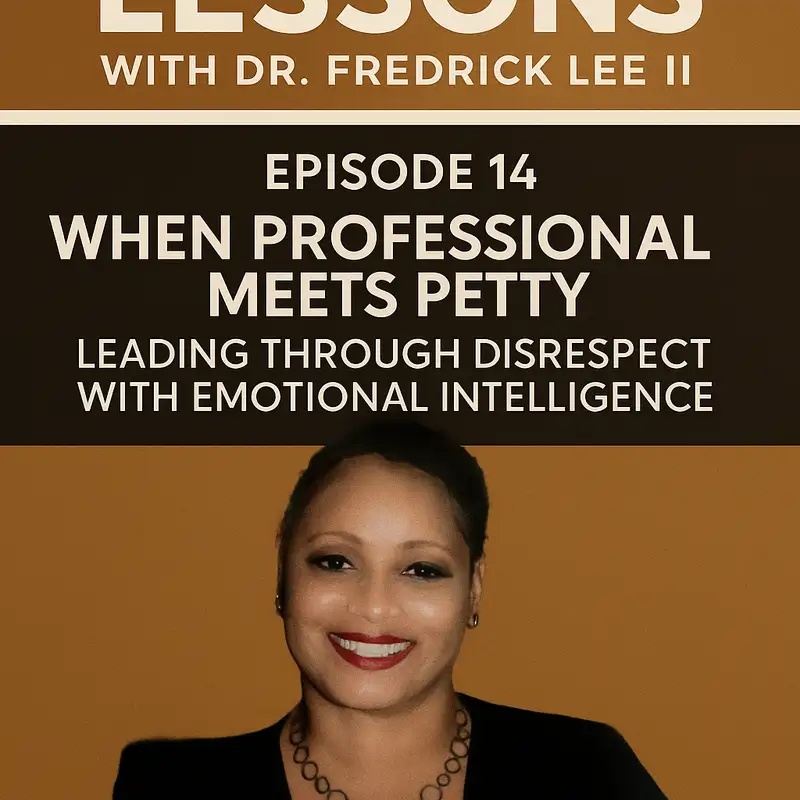
Ep. 14 When Professional Meets Petty: Leading Through Disrespect with Emotional Intelligence
Leadership Lessons with Dr. Fredrick Lee II
Episode 14: “When Professional Meets Petty – Leading Through Disrespect with Emotional Intelligence”
🎧 Opening Hook (2:30)
What do you do when the person you supervise no longer respects your leadership?
When every conversation feels like a battle of attitudes instead of a meeting of minds?
You’ve worked hard. You’ve earned your title. You show up every day trying to model professionalism — but deep down, you’re exhausted from walking the fine line between grace and grit.
That’s where today’s episode begins.
A listener, Morshelle Tease, reached out with a story that many of you will relate to. She said:
“I need some guidance on dealing with a coworker who’s my subordinate and has been rude and disrespectful. I’m trying my best to be professional, but I have to admit — the struggle is real. She’s upset that she wasn’t promoted based on longevity, but I was based on credentials and experience. I’m truly tired of playing nicely.”
Let’s pause there. Because what Morshelle describes isn’t just a personality clash — it’s a professional tension point that tests a leader’s emotional intelligence.
When you step into leadership — especially when you’ve been promoted over a peer — something shifts. You’re not just managing tasks anymore. You’re managing trust, emotions, and perception.
And that’s where emotional intelligence becomes more than a buzzword — it becomes your survival skill.
Today, we’re going to talk about what happens when professionalism meets pettiness — and how to lead through it with confidence, boundaries, and grace.
And this week, we’re doing something new.
We’re bringing you an actual coaching session that demonstrates the practical application of our world-famous Change Moves — real, reflective tools designed to help you pause, assess, and respond with purpose.
You’ll get to hear how a leader like Morshelle navigates disrespect while maintaining accountability and composure — and how you can do the same.
🧭 Topic Introduction (2:15)
Leadership will always test your emotional capacity.
It’s not just about managing others — it’s about controlling yourself when others challenge your authority, your patience, or your peace.
Emotional intelligence — or E.I. — equips leaders to lead effectively without being emotionally hijacked by others' behavior.
At its core, it’s built on four dimensions:
1. Self-Awareness – Knowing your triggers and patterns.
2. Self-Regulation – Managing your emotions under pressure.
3. Social Awareness – Understanding others’ emotions and motivations.
4. Relationship Management – Navigating conflict while maintaining professionalism.
And in leadership, especially when tension rises, these four dimensions serve as your guardrails—they protect your credibility, your tone, and your trust.
So today, as we move into Morshelle’s story, I want you to think about this:
“What does it look like to remain professional when someone refuses to act professionally toward you?”
That’s where we begin.
💬 Interview Introduction: Guest – Morshelle Tease (2:30)
Today’s guest, Morshelle Tease, is a dedicated professional who recently moved from being part of a team to leading that team.
Her promotion wasn’t about favoritism — it was about skill, education, and results. But one of her former peers didn’t take the change well.
Since that transition, Morshelle has faced rudeness, dismissive comments, and subtle resistance from that individual — someone who clearly feels that time served should outweigh credentials earned.
For Morshelle, the challenge isn’t whether she’s qualified. It’s about whether she can maintain her professionalism while enforcing accountability with someone who’s undermining her leadership.
And for many of you listening — you’ve been there—that fine line between wanting to keep the peace and needing to protect your position.
So before we get into coaching, I like to start with what I call foundation questions — the questions that help us define what’s really happening.
🧩 Foundation Questions (2:30)
When I begin coaching a leader through this kind of conflict, I start by helping them slow down and name the dynamics at play. Here are the questions—
1. What has this person specifically said or done that you consider disrespectful?
2. How have you responded so far — verbally, emotionally, or even silently?
3. What’s your biggest fear in addressing the issue directly?
4. What would “professional but firm” look like for you in this situation?
5. What outcome do you want, beyond just ‘peace’?
These questions set the foundation for emotional intelligence in action — they help us separate the person from the pattern, and the reaction from the response.
💼 Coaching Session: Guided Discovery with Morshelle (10:00)
Now that we’ve explored the background and emotional landscape, let’s move into what I call the discovery phase.
This isn’t about giving answers — it’s about creating awareness. Because in leadership, clarity doesn’t always come from knowing what to do; it comes from knowing why we do it.
So, I’m going to guide you through a series of reflections — what we call our Change Moves. Each one is designed to help you move from emotional reaction to intentional leadership.
They build on the four pillars of Emotional Intelligence — self-awareness, self-regulation, social awareness, and relationship management — and together, they help transform conflict into growth.
Let’s start at the beginning — with you.
Change Move 1 – Self-Awareness: “What emotion am I leading with right now?”
Before we can manage a situation, we have to manage ourselves.
Take a moment and check in with your body and your thoughts.
What’s showing up for you when you think about this coworker?
Is it frustration? Resentment? Maybe disappointment or fatigue?
Notice that emotion without judgment. Because emotions aren’t the problem — unacknowledged emotions are.
Now ask yourself: Is this emotion helping me lead, or is it hijacking my leadership?
Coaching Task: Pause for 30 seconds before your next challenging interaction. Write down what you’re feeling and why. Capture it in a journal or notes app.
Change Move 2 – Self-Regulation: “How can I stay composed and communicate with authority, not emotion?”
Once we know what we’re feeling, the next step is choosing how we show it.
Leadership composure doesn’t mean suppressing emotion — it means channeling it productively. So, when you feel tension rising, practice what I call the Pause of Power.
Take three slow breaths before speaking. Inhale to ground yourself. Exhale to release the frustration. Then, when you do respond, focus on the facts, not the feeling.
Use the SBI Method — Situation, Behavior, Impact:
“In yesterday’s meeting (situation), when you interrupted me mid-sentence (behavior), it made collaboration harder (impact).”
It’s clear. It’s calm. It’s professional.
Coaching Task: Practice this method with one upcoming conversation. Write the statement in advance so you can focus on delivery instead of reaction.
Change Move 3 – Social Awareness: “What might this person’s behavior be communicating beneath the surface?”
Now that you’ve managed your side of the emotion, let’s turn outward.
Behind every difficult behavior is usually an unmet need — and understanding that doesn’t excuse it, but it helps you respond strategically.
Ask yourself:
- What might this person be thinking or feeling?
- What might they be saying or doing that reveals that?
Maybe they feel overlooked. Maybe they’re afraid their experience no longer matters. Maybe they just don’t know how to process disappointment.
Seeing the human behind the hostility helps you separate the person from the problem.
Coaching Task: Create a quick Empathy Map. Write what you think this person might be thinking, feeling, saying, and doing — then identify one possible unmet need driving it.
Change Move 4 – Relationship Management: “What boundaries or expectations do I need to reinforce to maintain accountability?”
Once you’ve practiced empathy, it’s time to restore structure.
Empathy without accountability becomes enablement — and you can’t lead effectively from that place.
Boundaries are a form of respect — both for yourself and for the other person. So the next step is to address the behavior directly, clearly, and consistently.
Use what I call the 3 Cs Framework — Clarity, Consistency, Consequence.
- Clarity: “I want to make sure expectations are clear. Disrespectful communication isn’t acceptable in team meetings.”
- Consistency: Apply the same tone and standards to everyone — no exceptions.
- Consequence: Calmly outline next steps if the behavior continues.
Coaching Task: Schedule a private one-on-one conversation. Plan your words using the 3 Cs. Enter the discussion with calm authority, not emotion.
Change Move 5 – Integration: “How do I define professionalism with boundaries for myself as a leader?”
Finally, let’s bring it all together.
When tension is high, it’s easy to forget who you are as a leader. This last Change Move helps you anchor back to your values — to your identity.
Ask yourself:
“What do I want people to remember about how I led during hard moments?”
Coaching Task: Write your Personal Leadership Code — three short statements that define how you lead under pressure.
For example:
- “I lead with calm.”
- “I communicate with clarity.”
- “I hold others accountable with respect.”
This becomes your internal compass — a reminder of your standard when others forget theirs.
🪞 Thematic Wrap-Up (3:00)
Leadership is rarely tested when everything’s peaceful — it’s tested when tension walks into the room.
What you do in those moments determines how your team sees you, how you see yourself, and how trust gets built or broken.
Disrespect is a mirror — it reflects more about the other person than it does about you.
But how you respond? That’s the reflection of your leadership.
When you practice emotional intelligence:
- You learn to notice before you react.
- You speak with intention instead of impulse.
- You lead with empathy while upholding accountability.
You set the emotional temperature of the room.
So when you stay calm, the chaos loses its power.
That’s the heart of emotionally intelligent leadership — it’s not about being above the drama, it’s about being centered enough not to be pulled into it.
🎯 Closing Message (3:00)
If you’re listening right now and dealing with someone who challenges your authority — hear me clearly:
You don’t have to prove your position. You’ve already earned it.
Your professionalism is your power. Your consistency is your credibility. Your composure is your confirmation that you belong where you are.
Leadership isn’t about controlling people — it’s about maintaining your presence.
So when disrespect shows up, don’t shrink, and don’t shout.
Stand firm. Speak calmly. Lead clearly.
Because when a professional meets a petty person, your composure wins every time.
Until next time, lead with strength, lead with strategy, and always lead with emotional intelligence.
I’m Dr. Fredrick Lee, and this has been your Leadership Lesson.