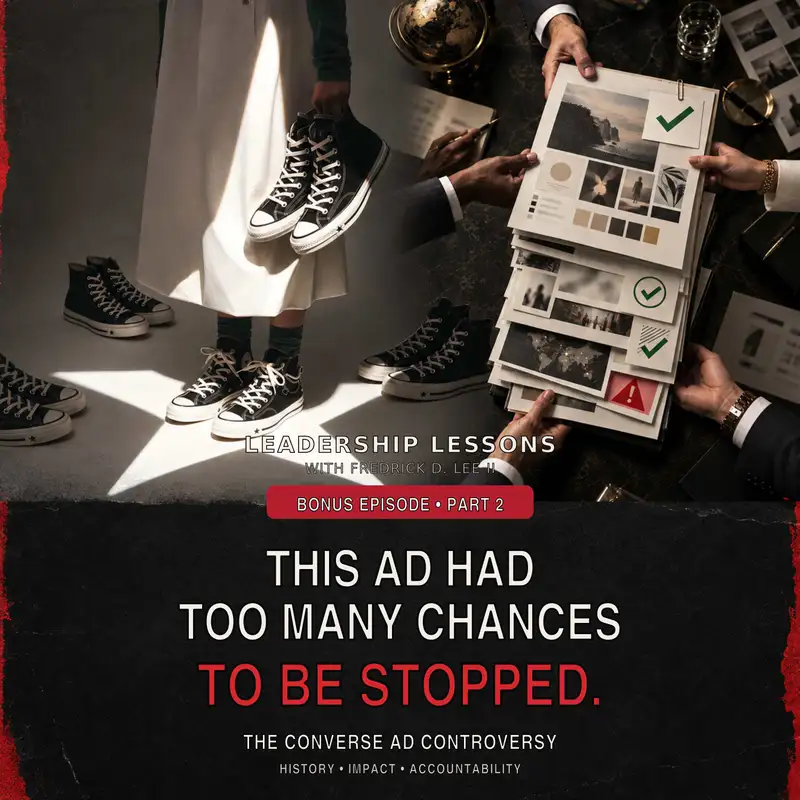
Bonus Episode, Part 2 This Ad Had Too Many Chances to Be Stopped
Bonus Episode, Part 2
This Ad Had Too Many Chances to Be Stopped
The Converse Ad Controversy: History, Impact and Accountability
This ad did not simply appear online. Before a global campaign reaches the public, it commonly moves through a series of decisions involving strategy, creative development, production, brand leadership, regional teams, legal or compliance, communications and final release authority.
We do not currently know the exact approval path used by Converse for these images. This episode does not claim to reconstruct a private process. Instead, it asks a leadership question based on the review systems commonly found inside large organizations:
How did nobody with enough authority recognize the risk and stop the release?
In This Episode Dr. Lee examines:
- Why a campaign can receive several approvals and still represent an organizational failure
- How responsibility becomes diluted when every department assumes someone else owns the larger cultural question
- Why legal approval does not automatically equal cultural responsibility
- The difference between representation, participation and decision-making authority
- Why organizations need people who can say, “Hold up. This is a problem,” without fearing retaliation
- How psychological safety influences whether employees raise difficult concerns
- Why employee voice means little when leadership is unwilling to listen
- How DEI can function as a decision-quality and risk-detection system
- Why diverse perspectives can create productive discomfort before a decision reaches the public
- The difference between the creator’s intent and the audience’s experienced impact
- Why a red-team review, cultural pre-mortem and clearly assigned stop authority should be part of major global campaigns
The Organizational Miss
A creative team may ask whether an image is visually compelling.
A marketing team may ask whether it will attract attention.
A product team may ask whether the merchandise is visible.
A legal team may ask whether the company can publish it.
A regional team may ask whether it translates across markets.
Communications may ask how the public could respond.
The problem arises when nobody is explicitly responsible for asking:
What historical meaning could this complete image carry, especially for communities whose experiences are not represented in the dominant interpretation?
When responsibility is spread across too many people, every approval mark can conceal the absence of real ownership.
Diversity Is Not Enough Without Authority
It is possible to have diverse people in a meeting and still make a culturally harmful decision.
If those employees are interrupted, dismissed, punished for raising concerns or brought into the process after the important decisions have already been made, their presence becomes symbolic. Representation without influence is not protection.
Effective inclusion requires access, psychological safety, decision authority and leadership responsiveness. Somebody must be able to identify a serious concern, pause the process and require the organization to reconsider the work.
Impact Versus Intent
The people involved may not have intended to evoke America’s history of racial terror. Intent still matters when evaluating motive. It does not erase the public impact of an image.
Leaders must be able to hold two truths at once:
The organization may not have intended harm, and the organization can still be responsible for the harm its choices produced.
Accountability begins when leaders stop treating intent as the end of the conversation.
Questions for Leaders
- Who is authorized to stop a campaign?
- At what stage are cultural and historical risks evaluated?
- Are employees rewarded or punished for challenging a popular idea?
- Is DEI present before the decision, or only after the backlash?
- Does every approval have a named owner?
- What happens when the organization receives a warning it does not want to hear?
A Note on Evidence
The research referenced in this episode did not directly study Converse or this particular advertising approval process. It informs the leadership analysis by examining psychological safety, employee voice, team diversity and organizational decision-making.
Sources and Further Reading
- Adweek: Converse Roils Social Media With Ads That Evoke a Lynching
- Amy Edmondson: Psychological Safety and Learning Behavior in Work Teams
- Elizabeth Morrison: Employee Voice and Silence
- Phillips, Liljenquist and Neale: Is the Pain Worth the Gain?
Coming in Part 3
You Cannot Apologize Away Your Impact
Part 3 examines what an organizational apology can and cannot accomplish, why accountability requires more than carefully written words and what leaders must do after trust has been damaged.
Content Notice: This episode discusses racism, racial violence, lynching imagery and other difficult historical subjects.
About the Host
Dr. Fredrick D. Lee II, Ed.D., brings together marketing, organizational leadership and organizational change to examine what public controversies reveal about leadership systems, workplace culture and accountability.
This has been your Leadership Lesson in organizational impact.